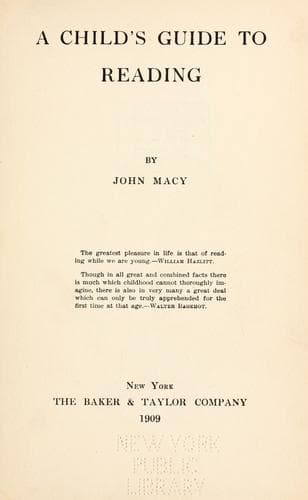
Books and reading; Children's literature -- Bibliography
“At any rate the close intercourse is admitted. Where is the house
now from which novels are tabooed? Is it not common to allow them
almost indiscriminately, so that young and old each chooses his own
novel? Shall he, then, to whom this close fellowship is allowed--this
inner confidence--shall he not be careful what words he uses, and
what thoughts he expresses, when he sits in council with his young
friend?... A novelist has two modes of teaching--by good example or
bad. It is not to be supposed that because the person treated of be
evil, therefore the precept will be evil. If so, some personages
with whom we have been acquainted from our youth upward would have
been omitted in our early lessons. It may be a question whether the
teaching is not more efficacious which comes from an evil example.
What story was ever more powerful in showing the beauty of feminine
reticence, and the horrors of feminine evildoing, than the fate of
Effie Deans [in “The Heart of Midlothian” by Scott]. The ‘Templar’ [in
Scott’s “Ivanhoe”] would have betrayed a woman to his lust, but has
not encouraged others by the freedom of his life. ‘Varney’ [in Scott’s
“Kenilworth”] was utterly bad--but though a gay courtier, he has
enticed no others to go the way he went. So has it been with Thackeray.
His examples have generally been of that kind--but they have all been
efficacious in their teaching on the side of modesty and manliness,
truth, and simplicity.”
To return to the elements of the novel, plot, character, description,
style, if we think of a score of great novels that have had many
readers for many years, we shall see that some novelists are blessed
with genius for one element more than for another, or that they have
chosen to put their energies into one or the other. And we shall see,
too, that few novels are perfect, few as nearly perfect as “Esmond,”
and that we should not expect them to be. All that we need demand is
that a writer give us enough of something to make the reading of his
book worth while.
Public-domain text, read in full here on John Shaqi.
Reviews
Reviews
No reviews yet
Be the first to share your thoughts on this work.
Join the Discussion
Join the discussion
Sign in to leave a comment or review.
Sign InorCreate an account