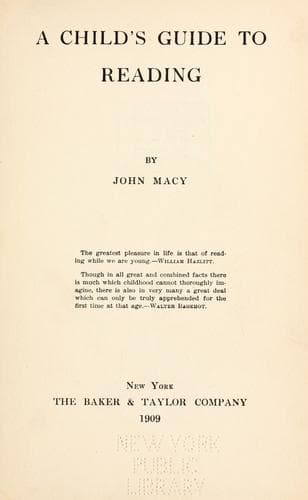
Books and reading; Children's literature -- Bibliography
Somebody once expressed the idea that he did not care for Dickens
because so many of his characters are low persons who would not be
interesting to associate with in real life; and other readers have
expressed the same idea, either sincerely or in thoughtless repetition.
If they do not like Dickens, it is probably for some other reason than
that Dickens portrays “common” people, for that reason is not broad
enough to stand on. These same readers may like another writer whose
characters are as low and uncultivated as most of the people whom
Dickens loved. If such a writer is not to be found in our libraries,
his first book may be still unpublished; he may walk to-morrow into the
town where we live, discover the humor and pathos of our commonplace
neighbors, and of the low persons whom we do not acknowledge as
neighbors. And ever after our village will be a shrine for tourists.
The great fiction writer is a magician; he upsets conventional values
in a flash and turns lead into gold in spite of all the chemists. The
true reader of fiction will be a believer in that miracle, and he will
keep his mind receptive to it in every form in which it manifests
itself.
CHAPTER IV
THE READING OF FICTION--(_Continued_)
In discussing the question of plots we could not keep out the question
of character, which we agreed for the purposes of our discussion is
the second element of fiction. In importance it is the first--the
indispensable element. What is fiction for except to tell us about
human beings? I cannot believe what somebody said, that the three
essentials of stories are first plot, second plot and third plot. In
the first place, that sounds too clever to be true and in the second
place--it is not true. The plot is the means of keeping persons in
action so that we can get to know them. In this “naturalists” and
“realists” find a good argument, for they put their emphasis on human
character. They say: “Here we exhibit you and your friends and your
enemies. Plot? We are telling a story. Stories are all about you. But
we have not forced events out of probable order or distorted the facts
of life beyond recognition for the sake of an exciting situation. We
draw our fellow men, so that you recognize them as they are. Even as
they are in their homes and shops and churches, so they are in these
pages, talking, loving, hating, bargaining, intriguing, dying. We
select the significant, we heighten the values of life; but we portray
life essentially as it is.” True enough. The realist gives us “folks.”
But he has no monopoly of human beings. We are quite as well acquainted
with Alice who wandered in Wonderland and went through the Looking
Glass as we are with Mr. David Copperfield and Miss Maggie Tulliver.
Peter Pan (in Mr. J. M. Barrie’s play), who flew in the face of nature
and refused to grow up, is so true a person that all the children
recognized him at once and old men chuckled and remembered him.
Public-domain text, read in full here on John Shaqi.
Reviews
Reviews
No reviews yet
Be the first to share your thoughts on this work.
Join the Discussion
Join the discussion
Sign in to leave a comment or review.
Sign InorCreate an account