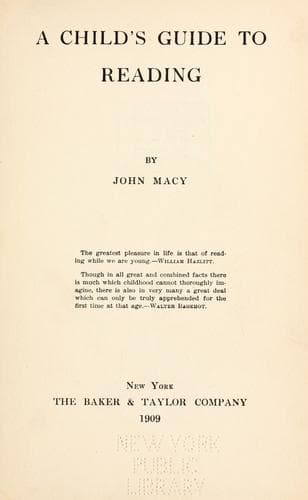
Books and reading; Children's literature -- Bibliography
The English novel is varied and abundant, and its characters,
collectively, form a populous democracy. Everybody is in it somewhere
from peasant to king, and if some of us and our friends have been left
out, new novelists are at hand watching every kind and grade of life
and preparing to fix it in a living page. The American novel is not yet
old and broad enough to have captured all our types of men and women
and recreated them in fiction. But a good beginning has been made. The
varied voices of the American country town are heard from all corners
of the land, but so far most of them have been voices of short compass,
incapable of sustained utterance. We still depend for studies of
American character on sketches and short stories, and these in the mass
are an important body of literature. New England, Virginia, California,
the Middle West, the great cities, have had their short-story writers.
The novelists are still on the way. Our national life is so scattered
and changing that the novelist has difficulty in keeping a group of
Americans together long enough to plot them into a large book. In
Europe where a small town contains every kind of society the novelist
finds the compact social stage all set and characters in abundance.
Anthony Trollope, with little care to plot, sets society to turning in
the quiet eddy of a small cathedral town and presently we are looking
into the heart of England. He introduces the same people into novel
after novel and we are always glad to see them again. The success of
his many novels supports the contention that characters are the staff
of fiction. A defect of plot is easier to pardon than a defect in
character drawing.
Untruth to human nature, violence either to its waking experiences or
its dreams, destroys a book, destroys the living world it represents
and leaves us holding a thing of ink and paper. The other day I was
reading a novel which has multiplied itself over the land by force
of printing presses and sensational advertising. It is a story about
modern people of an undistinguished but potentially interesting kind;
the heroine is, if I remember right, a confidential secretary to a
business man. The author makes her say something like this to her lover:
“Ere I knew you, there had come into my life but few pleasures and
diversions; I had been like a bird shut up in a cage; and you set me
free. Yet it was not that alone which attracted me to you. Grateful as
I was, I was charmed, too, by your conversation which was so totally
different than (_sic_) anything I had known heretofore. You saved me
from the wretched monotony of commonplace existence and took me into a
new world, and my gratitude for that blossomed into love”; and so on.
Public-domain text, read in full here on John Shaqi.
Reviews
Reviews
No reviews yet
Be the first to share your thoughts on this work.
Join the Discussion
Join the discussion
Sign in to leave a comment or review.
Sign InorCreate an account