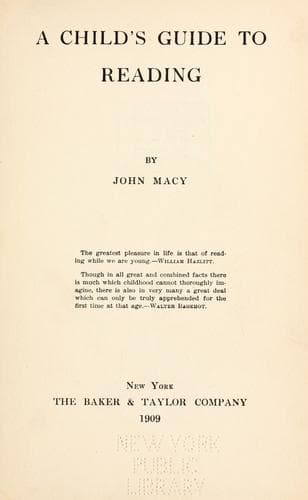
Books and reading; Children's literature -- Bibliography
In choosing novels the ordinary reader need not at first
concern himself with the history of a novelist or his technical
characteristics, or with the place which critics have given to him in
their schemes of literary development. A simple method of selection is
to find on somebody’s advice a novel that has interested many readers,
and then if it prove good, to try another by the same author. If a
writer has produced two novels that interest you, it is safe to assume
that he has written a third and a fourth. Some writers, it is true,
have been distinguished for a single masterpiece. “Don Quixote” is
the only book of Cervantes’ that we are likely to care for. “Robinson
Crusoe” is all that most people have found good in Defoe’s tales
(though there is much merit in his other stories). No other book of
Mrs. Stowe’s is even second to “Uncle Tom’s Cabin.” “The Vicar of
Wakefield” is the glorious whole of Goldsmith’s narrative prose,
though he succeeded in every other form of literature, including the
prose drama. But the man who can write two novels can write three if
he has time; the two-novel power is likely to be a ten-novel power
with torpedo fleets of short stories and essays. Anyone who has liked
“Silas Marner” and “Middlemarch” will not need to be urged to read
“Felix Holt,” “Adam Bede,” “Romola,” “The Mill on the Floss.” The
person who has once read and enjoyed two novels of Dickens is likely
to read six or eight. “Pendennis” leads to “The Newcomes.” And any
of Trollope’s “Barchester,” novels is an introduction to the happily
interminable series.
[Illustration: HAWTHORNE]
I have purposely said little about the short story, because in this day
of magazines we all read short stories, some of them pretty good ones.
There are fifty persons who can write one or two acceptable short tales
to one who can make a novel of moderate merit. And the great writers of
the tale have often been novelists as well, so that if one begins to
read novels one will meet with the best short stories which have been
worth collecting into volumes. Readers of “The House of Seven Gables”
and “The Scarlet Letter” will make the acquaintance of Hawthorne’s
“Twice Told Tales” and “Mosses from an Old Manse.” Among modern
fictionists of importance Poe stands almost alone as a writer of tales
who never tried the longer and greater form of the novel, though there
are several excellent authors, such as Mr. Rudyard Kipling, Miss Sarah
Orne Jewett, Mrs. Mary Wilkins-Freeman, whose short tales outweigh in
value, if not in quantity, their more extended narratives.
Public-domain text, read in full here on John Shaqi.
Reviews
Reviews
No reviews yet
Be the first to share your thoughts on this work.
Join the Discussion
Join the discussion
Sign in to leave a comment or review.
Sign InorCreate an account