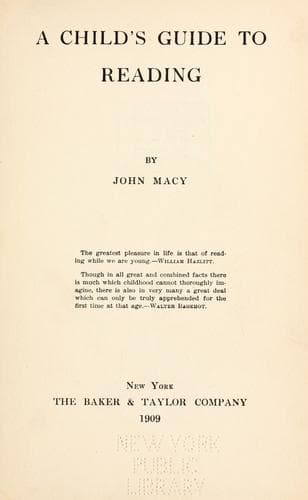
Books and reading; Children's literature -- Bibliography
Will take from both a deep, autumnal tone,
Sweet though in sadness. Be thou, spirit fierce,
My spirit! Be thou me, impetuous one!
Drive my dead thoughts over the universe
Like withered leaves to quicken a new birth!
And, by the incantation of this verse,
Scatter, as from an unextinguished hearth
Ashes and sparks, my words among mankind!
Be through my lips to unawakened earth
The trumpet of a prophecy! O, wind,
If Winter comes, can Spring be far behind?
[Illustration: SHELLEY]
Hear Browning, the athletic optimist:
The year’s at the spring
And day’s at the morn;
Morning’s at seven;
The hillside’s dew-pearled;
The lark’s on the wing;
The snail’s on the thorn:
God’s in his heaven--
All’s right with the world!
And of himself, at the close of his life, Browning sings:
One who never turned his back but marched breast forward,
Never doubted clouds would break,
Never dreamed, though right were worsted, wrong would triumph,
Held we fall to rise, ere baffled to fight better,
Sleep to wake.
Finally listen to the beauty-loving pessimist that Fitzgerald brought
out of Persia and set among the jewels in the crown of English poetry:
So when the Angel of the darker Drink
At last shall find you by the River-brink,
And, offering his Cup, invite your Soul
Forth to your Lips to quaff--you shall not shrink.
I sent my Soul through the Invisible,
Some letter of that After-life to spell:
And after many Days my Soul returned
And said, “Behold, Myself am Heaven and Hell.”
Here are four poets of different generations and different beliefs;
large volumes have been written to expound each and tell us the
meaning, the philosophy, the development, the tendencies, the influence
of this poet and that. But see them together: no explanation of their
_meanings_ can divide them, for they are all poets, and no group of
men on earth are liker one to another _in purpose_ than great poets
are like to each other. They are all singing the eternal in words of
unmatchable power. They are wondrously alike in their celebration of
beauty and high feelings.
The great poet differs not from other great poets, but from inferior
ones; he differs from his equals mainly in manner of expression. The
new poet is he who brings the old messages in ways that no other poet
has conceived, and the old poet is always new, because he has attained
to beautiful utterance of ideas that we cannot outgrow, which indeed
most of mankind have not yet reached. Prose becomes old-fashioned
(except the Bible, which has a special place in our life and is,
moreover, largely poetic in substance); the prose of Shakespeare’s
time and Milton’s is difficult to read, it seems written in an antique
language. But Shakespeare and Milton are the poetry of to-day and of
uncounted to-morrows.
Public-domain text, read in full here on John Shaqi.
Reviews
Reviews
No reviews yet
Be the first to share your thoughts on this work.
Join the Discussion
Join the discussion
Sign in to leave a comment or review.
Sign InorCreate an account