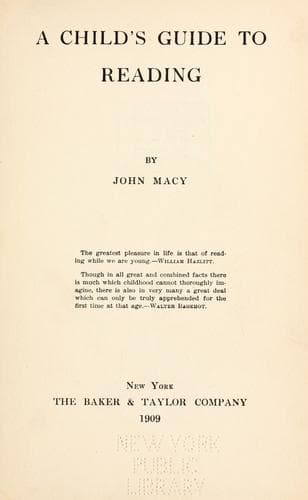
Books and reading; Children's literature -- Bibliography
In almost every American household there will be some volume of poetry
through which the young reader can make his entrance into the enchanted
world; there will be a volume of Shakespeare, an old copy of “Paradise
Lost” or the works of Longfellow or Tennyson. In our day a desire to
read is seldom thwarted by lack of books. Indeed, it sometimes seems
as if the very abundance of books made us so familiar with their backs
that we do not value the treasures inside. The biographies of our
grandfathers tell us of walks of five miles to secure some coveted
volume, and a volume so secured was not skimmed or neglected; the
effort to get it made it doubly precious.
If one is left to choose the door through which to enter the realm of
poetry, a good anthology will prove a broad approach. There is none
better than Palgrave’s “Golden Treasury of Songs and Lyrics.” It is
inexpensive, so that anyone can save enough pennies to buy it. It is
convenient to carry in one’s pocket, a virtue that makes it preferable
to larger anthologies, to those old-fashioned “household collections”
printed in double columns. If all our men and boys had the “Golden
Treasury” in their coat pockets, what a civilization we should have at
the end of ten years! In order to keep up with us the ladies would have
to provide pockets in their dresses or carry more spacious handbags
than the tyranny of style now permits.
The selections in Palgrave or in the four volumes of Ward’s “English
Poets,” are so rich and varied that no reader can fail to find his own
poet, and the next step will be to get a larger selection from that
poet’s works. All the English poets have been published in inexpensive
volumes of selections, many of them in the same _Golden Treasury
Series_; and as poets, like other human beings, are not always at their
best, an edition which contains only the best will save the reader
from the unfortunate experience of meeting a poet for the first time
in his inferior work. When we have learned really to like a poet, we
shall wish to have his complete works, but for the young reader most
modern poets are better for the suppression of their less admirable
passages. Only three or four--Spenser, Shakespeare, Milton, our
greatest poets--wrote long poems which to be enjoyed at their fullest
must be read entire. Although it is true that poetry consists of great
lines and that a collection of short poems and passages will be enough
to nourish the soul for its whole earthly life, yet supreme poetry is
built on a mighty plan. Brief lyrics and bits of song are like jewels,
precious, complete, beautiful. Great poems, epics and dramas, are
like cathedrals in which the jewels are set in the walls and in the
windows. One might read all the fine passages from Shakespeare and yet
not feel Shakespeare’s highest, that is, his entire, poetic power.
Public-domain text, read in full here on John Shaqi.
Reviews
Reviews
No reviews yet
Be the first to share your thoughts on this work.
Join the Discussion
Join the discussion
Sign in to leave a comment or review.
Sign InorCreate an account