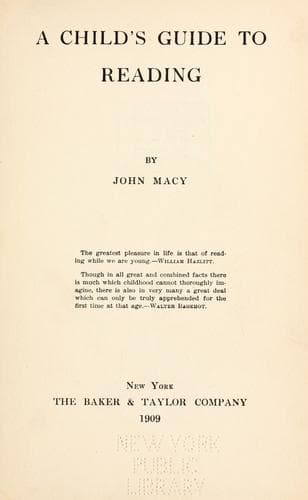
Books and reading; Children's literature -- Bibliography
John Stuart Mill records in his Autobiography how Wordsworth’s
poetry brought about in him a spiritual regeneration. At the age of
twenty-one, precociously far advanced in his study of economics and
philosophy, he found himself dejected and with no clear outlook upon
life. He had often heard of the uplifting power of poetry, and read
the whole of Byron, but Byron did him no good. He took up Wordsworth’s
poems “from curiosity, with no expectation of mental relief.” “I found
myself,” he says, “at once better and happier as I came under their
influence.” The reading of Wordsworth was the immediate occasion,
though not the sole cause, of a complete change in his way of thinking,
and his new way of thinking led him to life-long associations with
other great men.
We cannot tell which poet, which thinker, will do for us what
Wordsworth did for Mill. But while we are young we can take trial
excursions into literature until we find our own. And when we do find
our own, the treasure that is most precious to our souls, we shall know
it, and know it the better, perhaps, if we have tried many good books
and failed to like them.
If we are to rely so frankly upon our own likings, a word of caution
may be necessary to help us distinguish liberty of choice from
unreasonable license. We have to ask not only, Does this book interest
me?--but, Does this book appeal to the best tastes and emotions in me?
Many of us, by no means bad human beings, are so constituted that if
our eye meets the morbid, the coarse, the senselessly horrible, we are
fascinated, we are indeed interested. But it requires only the most
simple self-analysis and a little honesty, to pull ourselves together
and realize that it is an unworthy side of us, a side that we do not
care to show our friends, which is being held at attention. Not that
we need, like the stupidest of the old Puritans, be afraid of a book
simply because it does thrill us and make us breathless. For every bad
book which holds the depraved mind guiltily alert, a good book can be
found, so absorbing, so compelling, that beside it the bad book is tame.
I once had a pupil whose transparent honesty was only one of his many
lovable qualities. He believed that “Literature” consisted of dull
books written by authors who died long ago. The ill-reasoned conclusion
was his own, but I found that the raw materials of his error lay
in the prudishness of one of his teachers. When I told him that
“Huckleberry Finn,” by a very live author, is literature, and that a
short story by Mrs. Mary Wilkins-Freeman in a current magazine seemed
to me literature of rare excellence, his delight so aroused his wits
that for some time after that my part of the lessons consisted merely
in meeting his enthusiasm halfway.
Public-domain text, read in full here on John Shaqi.
Reviews
Reviews
No reviews yet
Be the first to share your thoughts on this work.
Join the Discussion
Join the discussion
Sign in to leave a comment or review.
Sign InorCreate an account