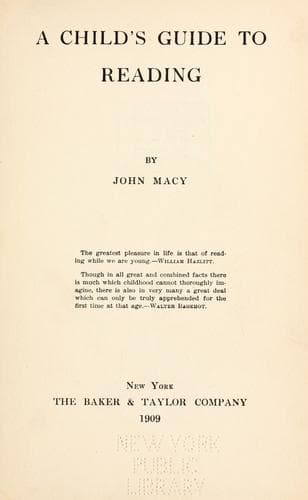
Books and reading; Children's literature -- Bibliography
A friend once asked me what he could read to improve his mind. In the
pride of a little superior wisdom, I loftily recommended Shakespeare.
His reply was, “That is too deep for me.” A wiser counselor than
I, knowing his circumstances, would not have tried to cultivate a
sprouting ambition with quite so perfect an intellectual instrument.
But I stuck to my advice, and shortly after I had opportunity to prove
that I was, if not wise, at least on the side of wisdom. We went
together to see “Othello”--from gallery seats. After that my friend
read the play and another that was bound with it.
Shakespeare is deep, forsooth. Hamlet’s soliloquy in the fourth act:
How all occasions do inform against me,
is so profound that it is darkened by its very depth. But the play
“Hamlet” is a stirring melodrama that keeps the “gallery gods” leaning
forward in their seats. The larger part of literature is by dead
authors, because the “great majority” of the race is dead and includes
its proportionate number of poets and prophets. Some great books _are_
dull except to a comparatively few minds in certain moods. But most
dull books by old writers have been forgotten; our ancestors saved
us the trouble of rejecting them. Most books that have survived are
triumphantly alive in all senses. The vitality of a book that is just
born may be brief as a candle flame. The old book that is still bright
has proved that its brightness is the true luster of the metal; else we
should not know its name.
CHAPTER II
THE PURPOSE OF READING
The question why we read books is one of those vast questions that need
no answer. As well ask, Why ought we to be good? or, Why do we believe
in a God? The whole universe of wisdom answers. To attempt an answer
in a chapter of a book would be like turning a spyglass for a moment
toward the stars. We take the great simple things for granted, like
the air we breathe. In a country that holds popular education to be
the foundation of all its liberties and fortunes, we do not find many
people who need to be argued into the belief that the reading of books
is good for us; even people who do not read much acknowledge vaguely
that they ought to read more.
There are, to be sure, men of rough worldly wisdom, even endowed with
spiritual insight, who distrust “book learning” and fall back on the
obvious truth that experience of life is the great teacher. Such
persons are in a measure justified in their conviction by the number of
unwise human beings who have read much but to no purpose.
The bookful blockhead, ignorantly read,
With loads of learned lumber in his head
Public-domain text, read in full here on John Shaqi.
Reviews
Reviews
No reviews yet
Be the first to share your thoughts on this work.
Join the Discussion
Join the discussion
Sign in to leave a comment or review.
Sign InorCreate an account