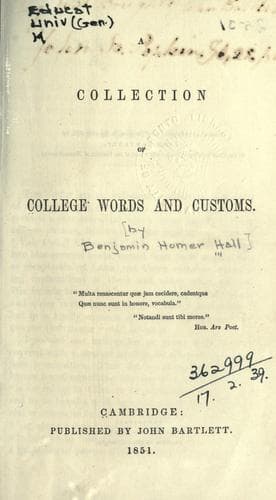
A Collection of College Words and CustomsHall, Benjamin Homer
History
A Collection of College Words and Customs
Hall, Benjamin Homer
College students -- United States -- Language; English language -- United States -- Slang; Slang
"Boots with yellow tops inverted, and coming up to the knee-band,
were commonly worn by men somewhat advanced in years; but the
younger portion more generally wore half-boots, as they were
called, made of elastic leather, cordovan. These, when worn, left
a space of two or three inches between the top of the boot and the
knee-band. The great beauty of this fashion, as it was deemed by
many, consisted in restoring the boots, which were stretched by
drawing them on, to shape, and bringing them as nearly as possible
into contact with the legs; and he who prided himself most on the
form of his lower limbs would work the hardest in pressure on the
leather from the ankle upward in order to do this most
effectually."--Vol. I. pp. 318-320.
In 1822 was passed the "Law of Harvard University, regulating the
dress of the students." The established uniform was as follows.
"The coat of black-mixed, single-breasted, with a rolling cape,
square at the end, and with pocket flaps; waist reaching to the
natural waist, with lapels of the same length; skirts reaching to
the bend of the knee; three crow's-feet, made of black-silk cord,
on the lower part of the sleeve of a Senior, two on that of a
Junior, and one on that of a Sophomore. The waistcoat of
black-mixed or of black; or when of cotton or linen fabric, of
white, single-breasted, with a standing collar. The pantaloons of
black-mixed or of black bombazette, or when of cotton or linen
fabric, of white. The surtout or great coat of black-mixed, with
not more than two capes. The buttons of the above dress must be
flat, covered with the same cloth as that of the garments, not
more than eight nor less than six on the front of the coat, and
four behind. A surtout or outside garment is not to be substituted
for the coat. But the students are permitted to wear black gowns,
in which they may appear on all public occasions. Night-gowns, of
cotton or linen or silk fabric, made in the usual form, or in that
of a frock coat, may be worn, except on the Sabbath, on exhibition
and other occasions when an undress would be improper. The
neckcloths must be plain black or plain white."
No student, while in the State of Massachusetts, was allowed,
either in vacation or term time, to wear any different dress or
ornament from those above named, except in case of mourning, when
he could wear the customary badges. Although dismission was the
punishment for persisting in the violation of these regulations,
they do not appear to have been very well observed, and gradually,
like the other laws of an earlier date on this subject, fell into
disuse. The night-gowns or dressing-gowns continued to be worn at
prayers and in public until within a few years. The black-mixed,
otherwise called OXFORD MIXED cloth, is explained under the latter
title.
Public-domain text, read in full here on John Shaqi.
Reviews
Reviews
No reviews yet
Be the first to share your thoughts on this work.
Elsewhere in the archive
Join the Discussion
Join the discussion
Sign in to leave a comment or review.
Sign InorCreate an account