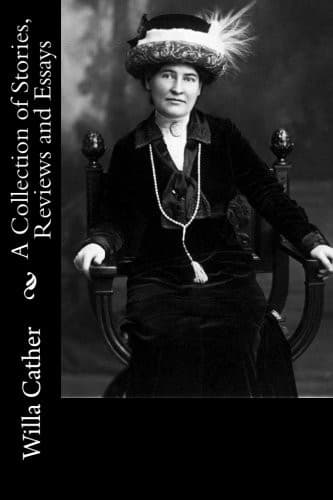
A Collection of Stories, Reviews and EssaysCather, Willa
General
A Collection of Stories, Reviews and Essays
Cather, Willa
Essays; Short stories; United States -- Social life and customs -- Fiction
Egypt" to "mingled and conflicting perfumes, reeking up from strange
convolute censers, together with multitudinous, flaring and
flickering tongues of purple and violet fire." Hungry and ragged he
wrote of Epicurean feasts and luxury that would have beggared the
purpled pomp of pagan Rome and put Nero and his Golden House to
shame.
And this mighty master of the organ of language, who knew its every
stop and pipe, who could awaken at will the thin silver tones of its
slenderest reeds or the solemn cadence of its deepest thunder, who
could make it sing like a flute or roar like a cataract, he was born
into a country without a literature. He was of that ornate school
which usually comes last in a national literature, and he came
first. American taste had been vitiated by men like Griswold and N.
P. Willis until it was at the lowest possible ebb. Willis was
considered a genius, that is the worst that could possibly be said.
In the North a new race of great philosophers was growing up, but
Poe had neither their friendship nor encouragement. He went indeed,
sometimes, to the chilly _salon_ of Margaret Fuller, but he was
always a discord there. He was a mere artist and he had no business
with philosophy, he had no theories as to the "higher life" and the
"true happiness." He had only his unshapen dreams that battled with
him in dark places, the unborn that struggled in his brain for
birth. What time has an artist to learn the multiplication table or
to talk philosophy? He was not afraid of them. He laughed at Willis,
and flung Longfellow's lie in his teeth, the lie the rest of the
world was twenty years in finding. He scorned the obtrusive learning
of the transcendentalists and he disliked their hard talkative
women. He left them and went back to his dream women, his
_Berenice_, his _Ligeia_, his _Marchesa Aphrodite_, pale and cold as
the mist maidens of the North, sad as the Norns who weep for human
woe.
Public-domain text, read in full here on John Shaqi.
Reviews
Reviews
No reviews yet
Be the first to share your thoughts on this work.
Elsewhere in the archive
Join the Discussion
Join the discussion
Sign in to leave a comment or review.
Sign InorCreate an account