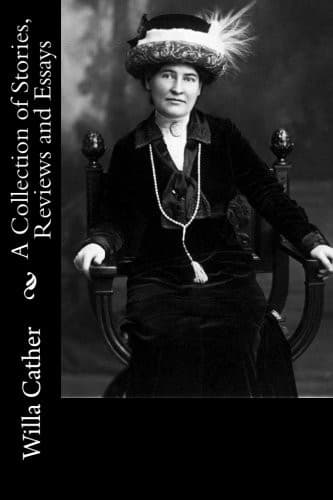
A Collection of Stories, Reviews and EssaysCather, Willa
General
A Collection of Stories, Reviews and Essays
Cather, Willa
Essays; Short stories; United States -- Social life and customs -- Fiction
The tragedy of Poe's life was not alcohol, but hunger. He died when
he was forty, when his work was just beginning. Thackeray had not
touched his great novels at forty, George Eliot was almost unknown
at that age. Hugo, Goethe, Hawthorne, Lowell and Dumas all did their
great work after they were forty years old. Poe never did his great
work. He could not endure the hunger. This year the Drexel Institute
has put over sixty thousand dollars into a new edition of Poe's
poems and stories. He himself never got six thousand for them
altogether. If one of the great and learned institutions of the land
had invested one tenth of that amount in the living author forty
years ago we should have had from him such works as would have made
the name of this nation great. But he sold "The Masque of the Red
Death" for a few dollars, and now the Drexel Institute pays a
publisher thousands to publish it beautifully. It is enough to make
Satan laugh until his ribs ache, and all the little devils laugh and
heap on fresh coals. I don't wonder they hate humanity. It's so
dense, so hopelessly stupid.
Only a few weeks before Poe's death he said he had never had time or
opportunity to make a serious effort. All his tales were merely
experiments, thrown off when his day's work as a journalist was
over, when he should have been asleep. All those voyages into the
mystical unknown, into the gleaming, impalpable kingdom of pure
romance from which he brought back such splendid trophies, were but
experiments. He was only getting his tools into shape getting ready
for his great effort, the effort that never came.
Bread seems a little thing to stand in the way of genius, but it
can. The simple sordid facts were these, that in the bitterest
storms of winter Poe seldom wrote by a fire, that after he was
twenty-five years old he never knew what it was to have enough to
eat without dreading tomorrow's hunger. Chatterton had only himself
to sacrifice, but Poe saw the woman he loved die of want before his
very eyes, die smiling and begging him not to give up his work. They
saw the depths together in those long winter nights when she lay in
that cold room, wrapped in Poe's only coat, he, with one hand
holding hers, and with the other dashing off some of the most
perfect masterpieces of English prose. And when he would wince and
turn white at her coughing, she would always whisper: "Work on, my
poet, and when you have finished read it to me. I am happy when I
listen." O, the devotion of women and the madness of art! They are
the two most awesome things on earth, and surely this man knew both
to the full.
Public-domain text, read in full here on John Shaqi.
Reviews
Reviews
No reviews yet
Be the first to share your thoughts on this work.
Elsewhere in the archive
Join the Discussion
Join the discussion
Sign in to leave a comment or review.
Sign InorCreate an account