Mr. Blomefield was, indeed, indebted to his deceased friend for the most
valuable parts of his History of Norwich, published in 1742. It is the
only part of his work which can be properly called history, the rest
consisting of topographical descriptions of different hundreds and
parishes in Norfolk. Mr. Blomefield began to print his “History of
Norfolk” at his own press in his own house at Fersfield, in 1739, by
subscription, and intended to publish a list of his subscribers when the
whole was finished. During his life the History came out in monthly
folio numbers; but he died when he had proceeded as far as page 678 of
the third volume. This volume was completed by the Rev. Charles Parkin,
rector of Oxburgh, Suffolk; and after his death was printed in 1769 by
Whittingham, bookseller at Lynn, by whom the “Continuation” was published
in two more volumes in 1777, these two volumes being very inferior to the
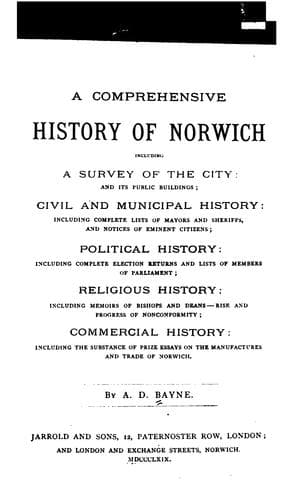
previous three. Blomefield’s work is of course the chief source of
information respecting Norwich, and it has been republished in many
abridged forms, the best edition being that printed by J. Crouse for M.
Booth, bookseller, in 1781, in ten vols., the last relating to Norwich.
Many smaller abridgements have also been published, carrying on the
narrative to a later date.
The most reliable authority for the whole of the eighteenth century is
the “Norfolk Remembrancer,” compiled with great care by Mr. Matchett. R.
Fitch, Esq., published a very full and accurate account of the Old Walls
and Gates from J. Kirkpatrick’s MSS., illustrated with views by the late
John Ninham. B. B. Woodward, Esq., F.S.A., librarian of the royal
library at Windsor Castle, has also been a contributor to the history of
the old city, but as yet we have only brief reports of his lectures “On
Norwich in the Olden Time,” as published in the local journals. He
directed attention to the purely fictitious accounts of the origin of the
city to be found in the early historians, who drew in all good faith on
their fertile imaginations. He gave a much more probable account, and
described the progress of the city at different periods, as quoted in the
following pages. Mr. Harrod, too, has contributed a good deal to more
accurate views of early periods, especially in relation to the
earth-works of the castle, and to the monasteries.
The chapters on the “Rise and Progress of Nonconformists in Norwich” in
this history, are the first given in any work of the kind, and supply
information which will readily account for the political condition of the
city. From a few hundreds in the seventeenth century, the Nonconformists
have so greatly increased that now they number many thousands, and have
at the same time attained to considerable wealth and influence.
Public-domain text, read in full here on John Shaqi.
Reviews
Reviews
No reviews yet
Be the first to share your thoughts on this work.
Join the Discussion
Join the discussion
Sign in to leave a comment or review.
Sign InorCreate an account