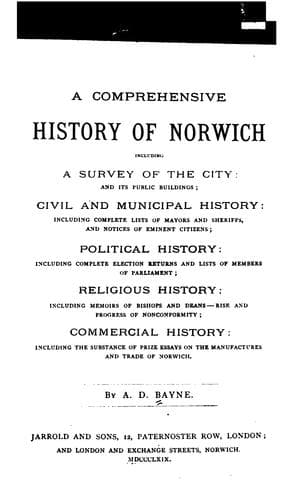
The chapters on Trade and Commerce supply a new feature in Norwich
history, and are very important to men of business. The information on
this head, including the history of the Manufactures and of the Wholesale
Trade of the city, is for the most part taken from Essays, by the
compiler, to which the prizes were awarded at the Norwich Industrial
Exhibition of 1867.
The great length of the secular narrative must suffice as an apology for
the brevity of the ecclesiastical details, which occupy the greater
portion of Blomefield’s work. A full history of the churches in Norwich
would fill many volumes; indeed, Kirkpatrick’s account of the Old
Religious Houses occupies as many as 300 pages. But the general reader
would not be interested by such details.
A full history of Norwich, up to the latest date, has long been wanted,
and the present compiler has availed himself of all sources of
information, but he has been obliged to compress a great deal into a
small compass. He has introduced many notices of eminent citizens of
every period, including bishops and ministers of all denominations, who
exercised much influence in their day and generation.
Accurate views of local history afford the clearest insight into the
state of society at different periods. Thus the records of Norwich
Castle prove that nearly all the land in the country was either assigned
to bear, or was chargeable with, the castle guard of some castle or other
in ancient times. The castles being fortresses were the centres around
which large towns arose, and where people most congregated for protection
in lawless ages. The whole island was one vast camp during the feudal
period. Monasteries were the only places of refuge for travellers, or
for the destitute poor, and when the religious houses were dissolved, an
entire change took place in the state of society.
Local history, properly understood, is not a dry register of events, but
leads from particular conclusions to higher generalisations. The
predominance of certain ideas at different times produced all the events
of those periods. Norwich men took an active part in all the great
movements of the day,—in the Reformation, the Civil Wars, the
Commonwealth, and all the agitations of more modern times. Therefore,
the story of the city is interesting and important in every period, and
it is identified with the whole course of events in East Anglia. Indeed,
it is difficult to separate the history of Norwich, the capital of East
Anglia, from that of the whole district.
[Picture: Decorative mark]
SUMMARY OF CONTENTS.
PART I.
PAGES
SURVEY OF NORWICH. Rise and Progress of the City—The 9–115
Modern City—Public Buildings—Parishes and Parish
Churches—Nonconformist Chapels.
PART II.
Public-domain text, read in full here on John Shaqi.
Reviews
Reviews
No reviews yet
Be the first to share your thoughts on this work.
Join the Discussion
Join the discussion
Sign in to leave a comment or review.
Sign InorCreate an account