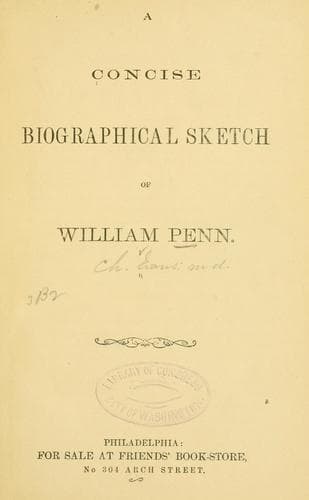
A Concise Biographical Sketch of William PennEvans, Charles
History
A Concise Biographical Sketch of William Penn
Evans, Charles
Penn, William, 1644-1718
Produced by The Online Distributed Proofreading Team at
http://www.pgdp.net. (This file was produced from images
generously made available by The Internet Archive/American
Libraries.)
A CONCISE BIOGRAPHICAL SKETCH OF WILLIAM PENN.
PHILADELPHIA:
FOR SALE AT FRIENDS' BOOK-STORE,
No 304 ARCH STREET.
BIOGRAPHICAL SKETCH OF WILLIAM PENN.
The following is a brief sketch of the life of one who, though perhaps
more widely known as the Proprietor and Founder of Pennsylvania, was
also eminent as a minister of the gospel in the Society of Friends, and
distinguished for his superior intellectual abilities, his varied
culture, and, above all, for his devoted Christian character,
exemplified both in adversity and prosperity. It is taken principally
from a work entitled "Friends in the Seventeenth Century."
He was the son of William Penn, who, trained to nautical life, had by
his genius and courage risen rapidly in the navy, until at the age of
twenty-nine he became "Vice-Admiral of the Straits." From the account of
his life and public career, given by Granville Penn, a descendant, he
appears to have been a man who made self-interest a leading principle of
conduct, but who, while eagerly coveting wealth and honor, was never
accused of being corrupt as a public servant. His son William was born
in London, in 1644, and resided with his mother at Wanstead, in Essex,
while his father was absent with the fleet over which he had command.
Owing to information received by Cromwell, through some of the spies
kept by him in attendance upon the exiled Charles and his court, that,
notwithstanding he had sanctioned the promotion of Admiral Penn, and
largely rewarded him by an estate in Ireland, for some losses he had
sustained there, he was secretly making overtures to bring the squadron
he commanded into the service of the Royalists, he lost favor with the
Protector. On his return from an unsuccessful expedition against the
Spanish West India Islands, he was deprived of his command and thrown
into prison, whence Cromwell generously liberated him at his own humble
petition. He then took his family over to Ireland, where he continued to
reside for some years, on the estate which Cromwell had had bestowed
upon him, and which was near Cork.
Public-domain text, read in full here on John Shaqi.
Reviews
Reviews
No reviews yet
Be the first to share your thoughts on this work.
Join the Discussion
Join the discussion
Sign in to leave a comment or review.
Sign InorCreate an account