French fiction -- Translations into English; Love -- Fiction; Man-woman relationships -- Fiction
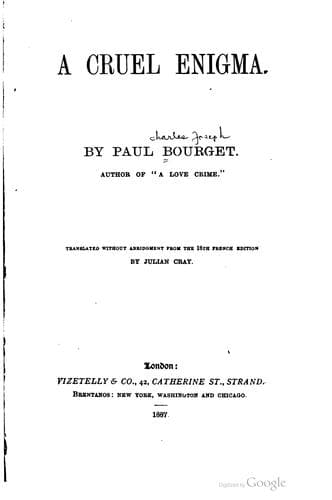
A CRUEL ENIGMA
BY PAUL BOURGET
AUTHOR OF "A LOVE CRIME"
TRANSLATED WITHOUT ABRIDGMENT FROM THE 18TH FRENCH EDITION
BY JULIAN CRAY
LONDON:
_VIZETELLY & CO., 42, CATHERINE ST., STRAND_
BRENTANOS: NEW YORK, WASHINGTON AND CHICAGO
1887
PAUL BOURGET.
A poet of merit, an acute, clear-sighted critic, and an accomplished and
successful novelist, M. Paul Bourget occupies an important position
among the brilliant crowd of modern French _littérateurs_, upon the
younger generation especially of whom he exercises an acknowledged and a
constantly widening influence. Nor will this influence appear other than
natural if it be borne in mind that, gifted with no mean qualifications
for the task, M. Bourget has made a deep and particular study of just
those problems which, to this self-conscious, introspective age of ours,
are possessed of an all-absorbing interest. Complex as his nature
undoubtedly is, and many-sided as its accomplishment might, to a first
and superficial view, appear, he is in all his writings primarily a
critic, while his criticism has, moreover, uniformly occupied itself
with the same objects, with the hidden movements of the mind, that is to
say, considered in their bearings upon external manifestation, with all
the varied promptings which underlie the surface of conduct.
For the prosecution of such psychological studies, M. Bourget is in
every needful particular well fitted. He possesses keen insight, and a
remarkable power of sympathetically appreciating the play and
counter-play of motives, passions, and delicate shades of feeling; while
he is also endowed with that tact, subtlety, refinement, and, above all,
exact lucidity of expression, by which a writer is enabled to convey his
divinings unimpaired to the reader. This flexibility of sympathy, with
its answering flexibility of language, enabling to the expression alike
of widely sundered and of delicately blending diversities of thought and
emotion, correspond to, and are, perhaps, partly the outcome of, a
richly varied life-experience. Just as M. Bourget has made himself
equally at home in London and in Florence, in Paris and in Morocco, so
is he equally at ease and equally successful whether he be engaged in
indicating some of the consequences wrought by cosmopolitan existence in
the characters of Stendhal, Tourgéniev, and Amiel; in analysing the
conceptions of modern love presented in the writings of Baudelaire and
M. Alexandre Dumas; in measuring the modifications produced by science
in the imaginations and diverse sensibilities of Flaubert, M. Leconte de
Lisle, and M. Taine; or, finally, in living the life of his own
fictitious characters, and portraying for us a Hubert or a Theresa de
Sauve.
Public-domain text, read in full here on John Shaqi.
Reviews
Reviews
No reviews yet
Be the first to share your thoughts on this work.
Join the Discussion
Join the discussion
Sign in to leave a comment or review.
Sign InorCreate an account