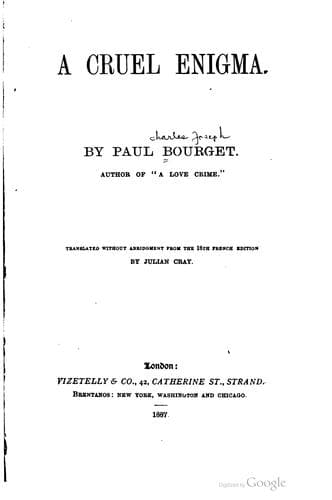
French fiction -- Translations into English; Love -- Fiction; Man-woman relationships -- Fiction
It is evident that the wielder of such exceptional powers must be
obvious to peculiar dangers with which the mere dead-level narrator of
outer phenomena has little or no acquaintance. To the very fulness of
these powers, and to their supremely overmastering presence are due
faults from which less gifted writers are shielded by their mediocrity
as by a wall. It would be possible, did space and inclination serve, to
point out instances of affectation both of idea and of expression in M.
Bourget's writings. As in the case of some of our own premier
authors--George Eliot, for instance, and Mr. George Meredith--his
thought is not invariably worthy of the richness of its setting, while
his analysis is occasionally pushed so far as to be superfluous, not to
say absurd. The charge of "literary dandyism" brought against him by M.
Jules Lemaitre is not destitute of foundation. It must be acknowledged
that his subtlety borders at times on pedantry, and his refinement on
conceit. Having said this, it is only fair to add that these flaws do
not enter excessively into the texture of his work; indeed, they rather
serve, by force of sufficiently rare and sharply defined contrast, to
throw into relief its general sterling excellence. And such
imperfections should not be allowed to weigh overmuch with us in
attempting to estimate the worth of our author's achievement. It is
notorious that--_si parva licet componere magnis_--there are spots on
the sun.
Conversant as he is with the entire gamut of human feeling, M. Bourget
has in all his novels--with the single exception of the last of them,
"André Cornélis"--elected to direct exclusive attention to the passion
of love. His treatment of this theme is as characteristic as it is
fresh. It is, further, in complete harmony with what appears to be his
doctrine of life. Accuracy of vision, assisted, doubtless, by the
breadth of cosmopolitan experience, has produced in him a result not
uncommon with men of his calibre. In spite of his own protestation to
the contrary, it has, in fact, made him a pessimist. Like Flaubert, with
whom he has some affinity, and one of the most striking of whose phrases
he, in the course of the following pages, unconsciously adopts, he
discerns too clearly to be greatly pleased with what he sees. The
pessimism of the two men was, however, arrived at by somewhat different
routes. Setting aside any origins of a purely physical nature, it arose
with Flaubert mainly from the inconsistency of his external surroundings
with his inward ideals, and denoted simply that his objective world and
his subjective world were at strife. M. Bourget's dissatisfaction flows
from the unpleasing result of his analyses of the inward feelings
themselves. He probes them and penetrates them throughout their complex
ramifications and windings until he reaches some ultimate fact or some
irreducible instinct, from which he draws the moral of an unbending
necessity.
Public-domain text, read in full here on John Shaqi.
Reviews
Reviews
No reviews yet
Be the first to share your thoughts on this work.
Join the Discussion
Join the discussion
Sign in to leave a comment or review.
Sign InorCreate an account