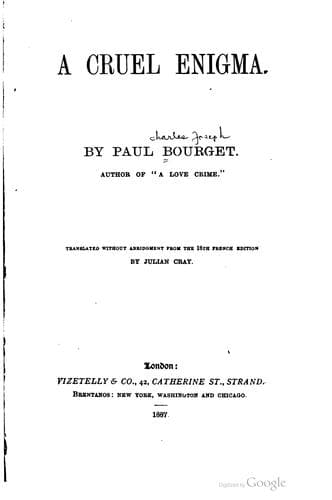
French fiction -- Translations into English; Love -- Fiction; Man-woman relationships -- Fiction
Madame Castel and her daughter believed in presentiments, double sight,
and somnambulists. They were persuaded that the Emperor Napoleon III.
had undertaken the Italian war in fulfilment of a carbonaro oath. Never
would these divinely good women have bestowed their friendship upon a
Protestant or an Israelite. The mere idea that there might be a
conscientious Freethinker would have disconcerted them as though they
had been told of the sanctity of a criminal. In short, even the General
thought them ingenuous. But, as it sometimes happens with officers
condemned to fleeting loves by their roving life and the timid feelings
hidden beneath their martial appearance Scilly was not well enough
acquainted with women to appreciate the reality of this ingenuousness or
the depth of the ignorance of evil in which the two Marie Alices lived.
He supposed that all virtuous women were similar, and he confounded all
others under the term of "queans." When his liver troubled him
excessively he would pronounce this word in a tone which gave grounds
for suspecting some bitter deception in his past life. But who among the
few people that he met at the house of "his two saints," as he called
Madame Castel and her daughter, dreamed of troubling themselves about
whether he had been deceived by some garrison adventuress or not?
Still lulled by the rolling of his carriage, the General continued to
resign himself to the memory-crisis through which he had been passing
since his departure from the Rue Vaneau, and which had caused him to
review, in a quarter of an hour, the entire existence of his friends.
Other faces also were evoked around these two forms, those, for
instance, of Madame de Trans, Madame Castel's first cousin, who lived in
the country for part of the year, and who used to come with her three
daughters, Yolande, Yseult and Ysabeau, to spend the winter at Paris.
These four ladies used to take up their abode in apartments in the Rue
de Monsieur, and their Parisian life consisted in hearing low mass at
seven o'clock in the morning in the private chapel of a convent situated
in the Rue de La Barouillère, in visiting other convents, or in busying
themselves in workrooms during the afternoon. They went to bed at about
half-past eight, after dining at noon and supping at six.
Public-domain text, read in full here on John Shaqi.
Reviews
Reviews
No reviews yet
Be the first to share your thoughts on this work.
Join the Discussion
Join the discussion
Sign in to leave a comment or review.
Sign InorCreate an account