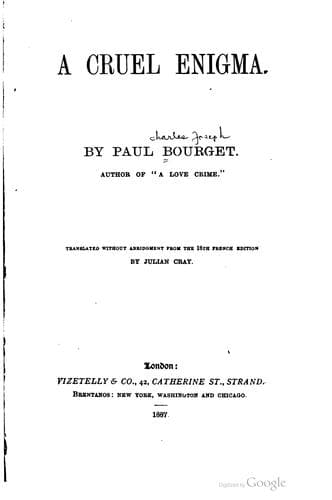
French fiction -- Translations into English; Love -- Fiction; Man-woman relationships -- Fiction
Perhaps the books with which the shelves of the last-named piece of
furniture were provided interpreted even better than all the other
details the anxious solicitude with which Madame Castel and Madame
Liauran had made every arrangement in order to remain mistresses of the
son during those difficult years which intervene between the twentieth
and the thirtieth. Having both, as soldiers' widows, preserved a
reverence for a life of action while, at the same time, their extreme
tenderness for Hubert rendered them incapable of enduring that he should
face it, they had found a compromise for their consciences in the dream
of a studious life for him. They ingenuously cherished a wish that he
should undertake a large and long work of military history, such as one
of the De Trans family had left behind him in the eighteenth century.
Was not this the best means for ensuring that he would remain a great
deal at home--that is to say, with them? Accordingly, thanks to Scilly's
advice, they had formed a tolerable collection of books suitable for
this project. Some religious works, a small number of novels, and, alone
among modern writers, the works of Lamartine completed the equipment of
the shelves.
It is right to say that in that corner of the world where no journal was
taken in, contemporary literature was completely unknown. The ideas of
the General and of the two women were identical on this point. And the
case was nearly the same in respect of the whole contemporary world as
it was in respect of literature. Astonishing conversations might have
been heard in that drawing-room in the Rue Vaneau, in the course of
which the Count would explain to his friends that France was governed by
the delegates of the secret societies, with other political theories of
similar scope. The same causes always produce the same effects.
Precisely as happens in very small country towns, monotony of habit had
resulted, with the two widows, in monotony of thought. Feelings were
very deep and ideas very narrow in that old house the entrance gate of
which was opened but rarely. On such occasions the passer-by could see,
at the end of a court, a building on the pediment of which might be read
a Latin motto, engraved in former times in honour of Marshal de Créquy,
the first owner of the house: _Marti invicto atque indefesso_--to
unconquered and indefatigable Mars. The lofty windows of the first
storey and of the ground floor, the old colour of the stone, the
appropriate silence of the court, all harmonised with the characters of
the two residents, whose prejudices were infinite.
Public-domain text, read in full here on John Shaqi.
Reviews
Reviews
No reviews yet
Be the first to share your thoughts on this work.
Join the Discussion
Join the discussion
Sign in to leave a comment or review.
Sign InorCreate an account