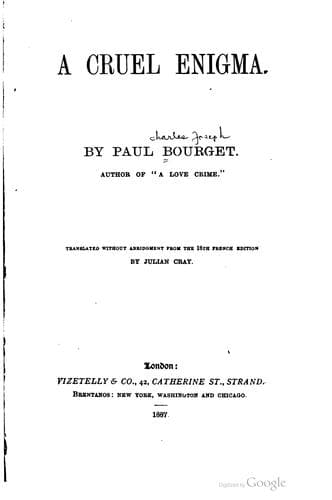
French fiction -- Translations into English; Love -- Fiction; Man-woman relationships -- Fiction
And here he finds the aspirings of his imagination and the
decrees of destiny at daggers drawn.
In these considerations we have a key to the proper interpretation of
the present volume. "Love," its author has said elsewhere, "has, like
death, remained irreducible to human conventions. It is wild and free in
spite of codes and modes. The woman who disrobes to give herself to a
man, lays aside her entire social personality with her garments. For him
she again becomes what he, too, becomes again for her--the natural,
solitary creature to whom no protection can guarantee happiness, and
from whom no decree can avert woe." These lines sum in brief the
teaching of the book. Its author has, after his own fashion, made an
uncompromising analysis of the passion that he undertakes to describe,
and, stripping from it all the adventitious grace and mysticism and
sentiment with which society is wont to shroud it, has found it to
consist, in the last resort, of a single and simple fact: the physical,
fleshly desire of man for woman and woman for man. Hence it is that
Theresa, while receiving, and rejoicing exceedingly in, Hubert's loftier
and more ideal affection, betrays it at the first opportunity for the
sensual brutishness of a hard-living _roué_, and hence, too, it is that
the pure-souled Hubert, even while he scorns his mistress for her
treachery and loathes himself for his weakness, returns loveless and
despairing to her arms.
The book is a pitiless study of the inevitable. We are made to feel
that, given the particular primary conditions, the results specified
could not but follow. It would almost seem that in the modern scientific
conception of the universal reign of Law, and the comparatively remote
possibilities of modifying its operation, we are approximating to a
renewed, but far more vividly realised, enthronement of the old Greek
idea of that Necessity against which the gods themselves were believed
to strive in vain, and M. Bourget is too completely a man of his century
not to reflect faithfully one of the most striking phases of latter-day
thought. The contemplation of a fatalistic ordering of the moral world
cannot be otherwise than exceptionally painful to one who, like M.
Bourget, is as sensitive to moral and spiritual, as he is to physical
and natural beauty. His nobler nature is wounded by the hard sequence of
inevitable law, and would fain have a deeply different moulding of
circumstance, but for all that the true novelist can tell us only what
he sees, and what he believes to be true, and so it comes to pass that
in M. Bourget's novels, with, perhaps, a single exception, we find the
eternal contrast between the "might be" and the "must be" consistently
indicated. In his "L'Irréparable" and its companion tale, "Deuxième
Amour," in "Crime d'Amour" and in "Cruelle Enigme," the topic which
engrosses him is still the same. In all alike we are sensible of the
antagonism between the cherished aspirations of the moralist and the
Public-domain text, read in full here on John Shaqi.
Reviews
Reviews
No reviews yet
Be the first to share your thoughts on this work.
Join the Discussion
Join the discussion
Sign in to leave a comment or review.
Sign InorCreate an account