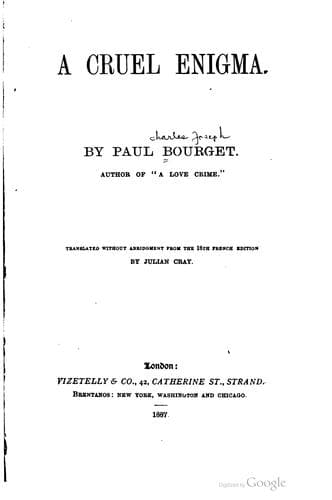
French fiction -- Translations into English; Love -- Fiction; Man-woman relationships -- Fiction
conclusions which the psychologist finds himself unwillingly compelled
to draw. And not in them only, but throughout his other writings also,
we can trace the spirit-workings of the man to whom life in its
entirety, no less than certain sorrowful phases of it is "a cruel
enigma."
JULIAN CRAY.
DEDICATION.
TO Mr. HENRY JAMES.
Allow me, my dear Henry James, to place your name on the first page of
this book in memory of the time at which I was beginning to write it,
and which was also the time when we became acquainted. In our
conversations in England last summer, protracted sometimes at one of the
tables in the hospitable Athenæum Club, sometimes beneath the shade of
the trees in some vast park, sometimes on the Dover esplanade while it
echoed to the tumult of the waves, we often discussed the art of
novel-writing, an art which is the most modern of all because it is the
most flexible, and the most capable of adaptation to the varied
requirements of every temperament. We were agreed that the laws imposed
upon novelists by the various æsthetics resolve themselves ultimately
into this: to give a personal impression of life. Will you find this
impression in "A Cruel Enigma"? I trust so, that this work may be truly
worthy of being offered to one whose rare and subtle talent, intelligent
sympathy, and noble character, I have been able to appreciate as reader,
fellow-worker, and friend.
P.B.
_Paris, 9th February_, 1885.
CONTENTS
CHAPTER I
CHAPTER II
CHAPTER III
CHAPTER IV
CHAPTER V
CHAPTER VI
CHAPTER VII
CHAPTER VIII
CHAPTER IX
CHAPTER X
CHAPTER XI
CHAPTER XII
A CRUEL ENIGMA.
CHAPTER I
All men accustomed to feel through their imaginations are well
acquainted with that unique description of melancholy which is inflicted
by too complete a likeness between a mother and her daughter, when the
mother is fifty years old and the daughter twenty-five, and the one
happens thus to exhibit the looked-for spectre of the old age of the
other. How fruitful in bitterness for a lover is such a vision of the
inevitable withering reserved for the beauty that he loves! To the eye
of a disinterested observer such likenesses abound in singularly
suggestive reflections. Rarely, indeed, does the analogy between the
features of the two faces extend to identity, and still more rarely are
the expressions completely alike. There has usually been a sort of
onward march in the common temperament from one generation to the next.
The predominant quality in the physiognomy has become more predominant
still--a visible symbol of a development of character produced by
heredity. Already too refined, the face has become still more so;
sensual, it has been materialised; wilful, it has grown hard and dry.
Public-domain text, read in full here on John Shaqi.
Reviews
Reviews
No reviews yet
Be the first to share your thoughts on this work.
Join the Discussion
Join the discussion
Sign in to leave a comment or review.
Sign InorCreate an account