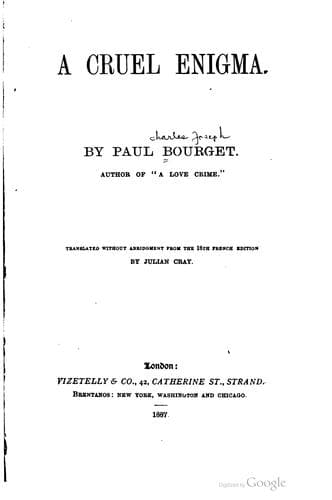
French fiction -- Translations into English; Love -- Fiction; Man-woman relationships -- Fiction
And it was just this intimate acquaintance with the life of these two
women which rendered the old man so strangely sensitive in respect of
them. He had identified himself with them to the extent of being unable
to sleep at night when he had left them visibly pre-occupied. This spare
man, sunk as it were into himself, in whom everything revealed strict
discipline from the stolidity of his look to the regularity of his gait,
and the punctilious rigour of his dress, disclosed, when his two friends
were in question, all those treasures of feeling which his mode of life
had given him little opportunity to expend; and on this evening, in the
month of February, 1880, he was in a state of agitation, like that of a
lover who has seen his mistress's eyes bathed in tears the cause of
which is unknown to him.
"What subject of grief can they have which they would not tell me?" This
question passed again and again through the General's head while his
carriage drove along, beaten by the wind and lashed by the rain. It was
"regular Prussian weather," as the Count's coachman expressed it; but
his master never thought of pulling up the open window through which
squalls were coming in every five minutes, and he constantly reverted to
his question, for his poor friends had been dreadfully dull the whole
evening, and the General could see them mentally just as his last glance
had caught them. The mother was seated in an easy-chair at the corner of
the fireplace, with her white hair, her profile which had not yet lost
its pride, and her strangely-black eyes set in a face wrinkled with
those long vertical wrinkles which tell of nobleness of life. The
extraordinary paleness of her colourless and, as it were, bloodless
complexion betrayed at all times the great sorrows of a widowhood which
had found nothing to divert or console it. But that evening this
paleness had appeared to the Count even more startling, as, too, had the
restlessness in the physiognomy of the daughter.
Although Madame Liauran was past forty, not one thread of silver mingled
as yet with the bands of black hair crowning the faded yet not withered
face, in which all her mother's features were reproduced, but with more
emaciation and pain. A nervous complaint kept her always lying on her
couch, which, that evening, was exactly opposite to Madame Castel's easy
chair, so that the General, on leaving the drawing-room had been able to
see both women at once, and to feel confusedly that on the second there
was weighing a double widowhood. No, there was nothing left in this
creature to enable her to support life without suffering. To Scilly, who
knew in what an atmosphere of tenderness and sorrow the second Marie
Alice had grown up, before herself entering an atmosphere of new
troubles, this sort of intensified widowhood afforded an easy
explanation of the existence in the daughter of a sensitiveness that was
already keen in the mother.
Public-domain text, read in full here on John Shaqi.
Reviews
Reviews
No reviews yet
Be the first to share your thoughts on this work.
Join the Discussion
Join the discussion
Sign in to leave a comment or review.
Sign InorCreate an account