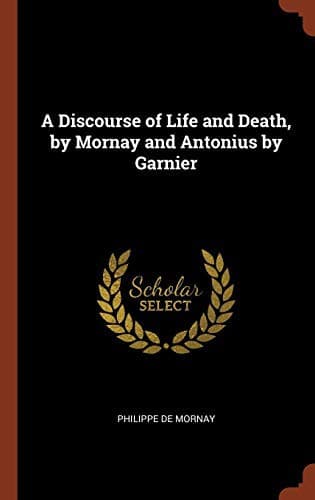
A Discourse of Life and Death, by Mornay; and Antonius by GarnierMornay, Philippe de, seigneur du Plessis-Marly
Religion
A Discourse of Life and Death, by Mornay; and Antonius by Garnier
Mornay, Philippe de, seigneur du Plessis-Marly
Antonius, Marcus, 83 B.C.?-30 B.C. -- Drama; Death -- Early works to 1800
feeles the euill present, laments the false pleasures past, and
sees for the time to come nothing to hope for. More foolish then
the childe, in bewailing the time he cannot recall, and not
remembring the euill hee had therein: and more wretched then the
yongman, in that after a wretched life not able, but wretchedly
to die, he sees on all sides but matter of dispaire. As for him,
who from his youth hath vndertaken to combate against the flesh,
and against the world: who hath taken so great paines to
mortifie himselfe and leaue the worlde before his time: who
besides those ordinarie euilles findes himselfe vexed with this
great and incurable disease of olde age, and feeles
notwithstanding his flesh howe weake soeuer, stronger oftentimes
then his spirite: what good I pray can hee haue but onlie
herein: that hee sees his death at hand, that hee sees his
combate finished, that he sees himselfe readie to departe by
death out of this loathsome prison, wherein all his life time
hee hath beene racked and tormented? I will not heere speake of
the infinite euilles wherewith men in all ages are annoyed, as
losse of friendes and parents, banishments, exiles, disgraces,
and such others, common and ordinarie in the world: one
complayning of loosing his children, an other of hauing them:
one making sorrow for his wifes death, an other for her life,
one finding faulte, that hee is too high in Courte, an other,
that hee is not high enough. The worlde is so full of euilles,
that to write them all, woulde require an other worlde as great
as it selfe. Sufficeth, that if the most happie in mens opinions
doe counterpoize his happs with his mishaps, he shall iudge
himselfe vnhappy: and hee iudge him happy, who had he beene set
three dayes in his place, would giue it ouer to him that came
next: yea, sooner then hee, who shall consider in all the goodes
that euer hee hath had the euilles hee hath endured to get them,
and hauing them to retaine and keepe them (I speake of the
pleasures that may be kept, and not of those that wither in a
moment) wil iudge of himselfe, and by himselfe, that the keeping
it selfe of the greatest felicitie in this worlde, is full of
vnhappinesse and infelicitie. Conclude then, that Childhoode is
but a foolish simplicitie, Youth, a vaine heate, Manhoode,
a painefull carefulnesse, and Olde-age, a noysome languishing:
that our playes are but teares, our pleasures, feuers of the
minde, our goodes, rackes, and torments, our honors, heauy
vanities, our rest, vnrest: that passing from age to age is but
passing from euill to euill, and from the lesse vnto the
greater: and that alwayes it is but one waue driuing on an
other, vntill we be arriued at the Hauen of death. Conclude I
say, that life is but a wishing for the future, and a bewailing
of the past: a loathing of what wee haue tasted, and a longing
for that wee haue not tasted, a vaine memorie of the state past,
and a doubtfull expectation of the state to come: finally, that
Public-domain text, read in full here on John Shaqi.
Reviews
Reviews
No reviews yet
Be the first to share your thoughts on this work.
Join the Discussion
Join the discussion
Sign in to leave a comment or review.
Sign InorCreate an account