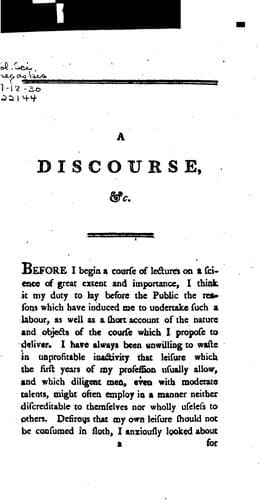
A Discourse on the Study of the Law of Nature and NationsMackintosh, James, Sir
Philosophy
A Discourse on the Study of the Law of Nature and Nations
Mackintosh, James, Sir
International law; Natural law
itself had occasioned, and this perhaps is all it is good for; it casts
no additional light upon the paths of life, but disperses the clouds
with which it had overspread them before; it advances not the traveller
one step in his journey, but conducts him back again to the spot from
whence he wandered. Thus the land of Philosophy consists partly of an
open champaign country, passable by every common understanding, and
partly of a range of woods, traversable only by the speculative, and
where they too frequently delight to amuse themselves. Since then we
shall be obliged to make incursions into this latter tract, and shall
probably find it a region of obscurity, danger, and difficulty, it
behoves us to use our utmost endeavours for enlightening and smoothing
the way before us."[17] We shall, however, remain in the forest only
long enough to visit the fountains of those streams which flow from it,
and which water and fertilise the cultivated region of Morals, to become
acquainted with the modes of warfare practised by its savage
inhabitants, and to learn the means of guarding our fair and fruitful
land against their desolating incursions. I shall hasten from
speculations, to which I am naturally, perhaps, but too prone, and
proceed to the more profitable consideration of our practical duty.
II. The first and most simple part of ethics is that which regards the
duties of private men towards each other, when they are considered apart
from the sanction of positive laws. I say, _apart_ from that sanction,
not _antecedent_ to it; for though we _separate_ private from political
duties for the sake of greater clearness and order in reasoning, yet we
are not to be so deluded by this mere arrangement of convenience as to
suppose that human society ever has subsisted, or ever could subsist,
without being protected by government and bound together by laws. All
these relative duties of private life have been so copiously and
beautifully treated by the moralists of antiquity, that few men will now
choose to follow them who are not actuated by the wild ambition of
equalling Aristotle in precision, or rivalling Cicero in eloquence.
They have been also admirably treated by modern moralists, among whom it
would be gross injustice not to number many of the preachers of the
Christian religion, whose peculiar character is that spirit of universal
charity, which is the living principle of all our social duties. For it
was long ago said, with great truth, by Lord Bacon, "that there never
was any philosophy, religion, or other discipline, which did so plainly
and highly exalt that good which is communicative, and depress the good
which is private and particular, as the Christian faith."[18] The
appropriate praise of this religion is not so much, that it has taught
new duties, as that it breathes a milder and more benevolent spirit over
the whole extent of morals.
Public-domain text, read in full here on John Shaqi.
Reviews
Reviews
No reviews yet
Be the first to share your thoughts on this work.
Join the Discussion
Join the discussion
Sign in to leave a comment or review.
Sign InorCreate an account