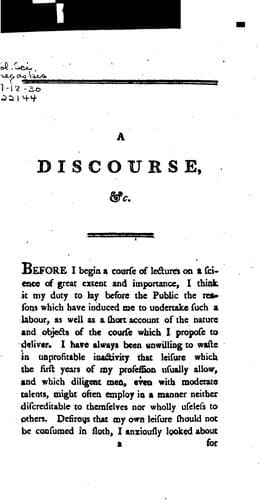
A Discourse on the Study of the Law of Nature and NationsMackintosh, James, Sir
Philosophy
A Discourse on the Study of the Law of Nature and Nations
Mackintosh, James, Sir
International law; Natural law
On a subject which has been so exhausted, I should naturally have
contented myself with the most slight and general survey, if some
fundamental principles had not of late been brought into question,
which, in all former times, have been deemed too evident to require the
support of argument, and almost too sacred to admit the liberty of
discussion. I shall here endeavour to strengthen some parts of the
fortifications of morality which have hitherto been neglected, because
no man had ever been hardy enough to attack them. Almost all the
relative duties of human life will be found more immediately, or more
remotely, to arise out of the two great institutions of property and
marriage. They constitute, preserve, and improve society. Upon their
gradual improvement depends the progressive civilization of mankind; on
them rests the whole order of civil life. We are told by Horace, that
the first efforts of lawgivers to civilise men consisted in
strengthening and regulating these institutions, and fencing them round
with rigorous penal laws.
Oppida coeperunt munire et ponere leges
Neu quis fur esset, neu quis latro, neu quis adulter.
1 _Serm._ iii. 105.
A celebrated ancient orator, of whose poems we have but a few fragments
remaining, has well described the progressive order in which human
society is gradually led to its highest improvements under the
guardianship of those laws which secure property and regulate marriage.
Et leges sanctas docuit, et chara jugavit
Corpora conjugiis; et magnas condidit urbes.
_Frag. C. Licin. Calvi._
These two great institutions convert the selfish as well as the social
passions of our nature into the firmest bands of a peaceable and orderly
intercourse; they change the sources of discord into principles of
quiet; they discipline the most ungovernable, they refine the grossest,
and they exalt the most sordid propensities; so that they become the
perpetual fountain of all that strengthens, and preserves, and adorns
society; they sustain the individual, and they perpetuate the race.
Around these institutions all our social duties will be found at various
distances to range themselves; some more near, obviously essential to
the good order of human life, others more remote, and of which the
necessity is not at first view so apparent; and some so distant, that
their importance has been sometimes doubted, though upon more mature
consideration they will be found to be outposts and advanced guards of
these fundamental principles: that man should securely enjoy the fruits
of his labour, and that the society of the sexes should be so wisely
ordered as to make it a school of the kind affections, and a fit nursery
for the commonwealth.
Public-domain text, read in full here on John Shaqi.
Reviews
Reviews
No reviews yet
Be the first to share your thoughts on this work.
Join the Discussion
Join the discussion
Sign in to leave a comment or review.
Sign InorCreate an account