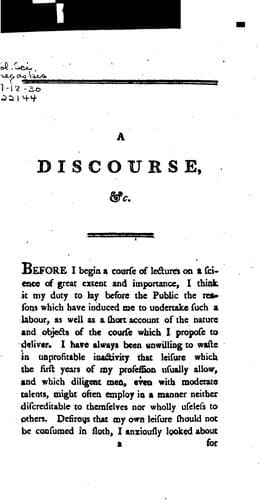
A Discourse on the Study of the Law of Nature and NationsMackintosh, James, Sir
Philosophy
A Discourse on the Study of the Law of Nature and Nations
Mackintosh, James, Sir
International law; Natural law
III. Having established the principles of private duty, I shall proceed
to consider man under the important relation of subject and sovereign,
or, in other words, of citizen and magistrate. The duties which arise
from this relation I shall endeavour to establish, not upon supposed
compacts, which are altogether chimerical, which must be admitted to be
false in fact, which if they are to be considered as fictions, will be
found to serve no purpose of just reasoning, and to be equally the
foundation of a system of universal despotism in Hobbes, and of
universal anarchy in Rousseau; but on the solid basis of general
convenience. Men cannot subsist without society and mutual aid; they can
neither maintain social intercourse nor receive aid from each other
without the protection of government; and they cannot enjoy that
protection without submitting to the restraints which a just government
imposes. This plain argument establishes the duty of obedience on the
part of citizens, and the duty of protection on that of magistrates, on
the same foundation with that of every other moral duty; and it shews,
with sufficient evidence, that these duties are reciprocal; the only
rational end for which the fiction of a contract could have been
invented. I shall not encumber my reasoning by any speculations on the
origin of government; a question on which so much reason has been wasted
in modern times; but which the ancients[21] in a higher spirit of
philosophy have never once mooted. If our principles be just, the origin
of government must have been coeval with that of mankind; and as no
tribe has ever yet been discovered so brutish as to be without some
government, and yet so enlightened as to establish a government by
common consent, it is surely unnecessary to employ any serious argument
in the confutation of a doctrine that is inconsistent with reason, and
unsupported by experience. But though all inquiries into the origin of
government be chimerical, yet the history of its progress is curious and
useful. The various stages through which it passed from savage
independence, which implies every man's power of injuring his neighbour,
to legal liberty, which consists in every man's security against wrong;
the manner in which a family expands into a tribe, and tribes coalesce
into a nation; in which public justice is gradually engrafted on private
revenge, find temporary submission ripened into habitual obedience; form
a most important and extensive subject of inquiry, which comprehends all
the improvements of mankind in police, in judicature, and in
legislation.
Public-domain text, read in full here on John Shaqi.
Reviews
Reviews
No reviews yet
Be the first to share your thoughts on this work.
Join the Discussion
Join the discussion
Sign in to leave a comment or review.
Sign InorCreate an account