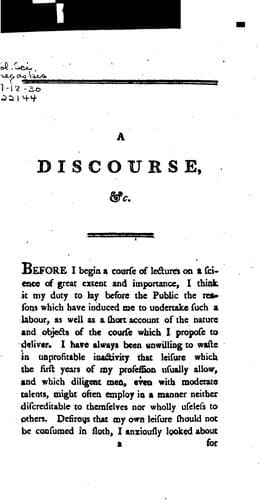
A Discourse on the Study of the Law of Nature and NationsMackintosh, James, Sir
Philosophy
A Discourse on the Study of the Law of Nature and Nations
Mackintosh, James, Sir
International law; Natural law
I have already given the reader to understand that the description of
liberty which seems to me the most comprehensive, is that of _security
against wrong_. Liberty is therefore the object of all government. Men
are more free under every government, even the most imperfect, than they
would be if it were possible for them to exist without any government
at all: they are more secure from wrong, _more undisturbed in the
exercise of their natural powers, and therefore more free, even in the
most obvious and grossest sense of the word_, than if they were
altogether unprotected against injury from each other. But as general
security is enjoyed in very different degrees under different
governments, those which guard it most perfectly, are by way of eminence
called _free_. Such governments attain most completely the end which is
common to all government. A free constitution of government and a good
constitution of government are therefore different expressions for the
same idea.
Another material distinction, however, soon presents itself. In most
civilised states the subject is tolerably protected against gross
injustice from his fellows by impartial laws, which it is the manifest
interest of the sovereign to enforce. But some commonwealths are so
happy as to be founded on a principle of much more refined and provident
wisdom. The subjects of such commonwealths are guarded not only against
the injustice of each other, but (as far as human prudence can
contrive) against oppression from the magistrate. Such states, like all
other extraordinary examples of public or private excellence and
happiness, are thinly scattered over the different ages and countries of
the world. In them the will of the sovereign is limited with so exact a
measure, that his protecting authority is not weakened. Such a
combination of skill and fortune is not often to be expected, and indeed
never can arise, but from the constant though gradual exertions of
wisdom and virtue, to improve a long succession of most favourable
circumstances.
Public-domain text, read in full here on John Shaqi.
Reviews
Reviews
No reviews yet
Be the first to share your thoughts on this work.
Join the Discussion
Join the discussion
Sign in to leave a comment or review.
Sign InorCreate an account