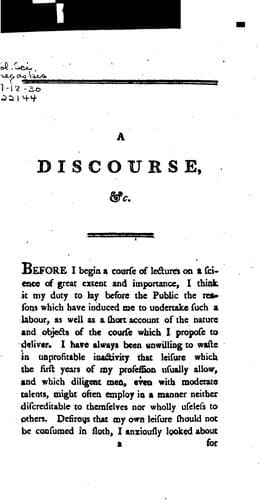
A Discourse on the Study of the Law of Nature and NationsMackintosh, James, Sir
Philosophy
A Discourse on the Study of the Law of Nature and Nations
Mackintosh, James, Sir
International law; Natural law
There is indeed scarce any society so wretched as to be destitute of
some sort of weak provision against the injustice of their governors.
Religious institutions, favourite prejudices, national manners, have in
different countries, with unequal degrees of force, checked or mitigated
the exercise of supreme power. The privileges of a powerful nobility, of
opulent mercantile communities, of great judicial corporations, have in
some monarchies approached more near to a control on the sovereign.
Means have been devised with more or less wisdom to temper the despotism
of an aristocracy over their subjects, and in democracies to protect the
minority against the majority, and the whole people against the tyranny
of demagogues. But in these unmixed forms of government, as the right of
legislation is vested in one individual or in one order, it is obvious
that the legislative power may shake off all the restraints which the
laws have imposed on it. All such governments, therefore, tend towards
despotism, and the securities which they admit against mis-government
are extremely feeble and precarious. The best security which human
wisdom can devise, seems to be the distribution of political authority
among different individuals and bodies, with separate interests and
separate characters, corresponding to the variety of classes of which
civil society is composed, each interested to guard their own order from
oppression by the rest; each also interested to prevent any of the
others from seizing on exclusive, and therefore despotic power; and all
having a common interest to co-operate in carrying on the ordinary and
necessary administration of government. If there were not an interest to
resist each other in extraordinary cases, there would not be liberty. If
there were not an interest to co-operate in the ordinary course of
affairs, there could be no government. The object of such wise
institutions which make the selfishness of governors a security against
their injustice, is to protect men against wrong both from their rulers
and their fellows. Such governments are, with justice, peculiarly and
emphatically called _free_; and in ascribing that liberty to the skilful
combination of mutual dependence and mutual check, I feel my own
conviction greatly strengthened by calling to mind, that in this opinion
I agree with all the wise men who have ever deeply considered the
principles of politics; with Aristotle and Polybius, with Cicero and
Tacitus, with Bacon and Machiavel, with Montesquieu and Hume.[22] It is
impossible in such a cursory sketch as the present, even to allude to a
very small part of those philosophical principles, political reasonings,
and historical facts, which are necessary for the illustration of this
momentous subject. In a full discussion of it I shall be obliged to
examine the general frame of the most celebrated governments of ancient
and modern times, and especially of those which have been most renowned
for their freedom.
Public-domain text, read in full here on John Shaqi.
Reviews
Reviews
No reviews yet
Be the first to share your thoughts on this work.
Join the Discussion
Join the discussion
Sign in to leave a comment or review.
Sign InorCreate an account