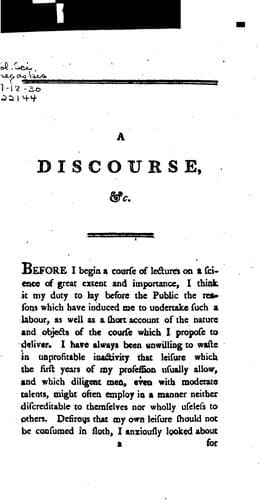
A Discourse on the Study of the Law of Nature and Nations — John Shaqi
A Discourse on the Study of the Law of Nature and NationsMackintosh, James, Sir
Philosophy
A Discourse on the Study of the Law of Nature and Nations
Mackintosh, James, Sir
International law; Natural law
The first principles of jurisprudence are simple maxims of reason, of
which the observance is immediately discovered by experience to be
essential to the security of men's rights, and which pervade the laws of
all countries. An account of the gradual application of these original
principles, first, to more simple, and afterwards to more complicated
cases, forms both the history and the theory of law. Such an historical
account of the progress of men, in reducing justice to an applicable and
practical system, will enable us to trace that chain, in which so many
breaks and interruptions are perceived by superficial observers, but
which in truth inseparably, though with many dark and hidden windings,
links together the security of life and property with the most minute
and apparently frivolous formalities of legal proceeding. We shall
perceive that no human foresight is sufficient to establish such a
system at once, and that, if it were so established, the occurrence of
unforeseen cases would shortly altogether change it; that there is but
one way of forming a civil code, either consistent with common sense, or
that has ever been practised in any country, namely, that of gradually
building up the law in proportion as the facts arise which it is to
regulate. We shall learn to appreciate the merit of vulgar objections
against the subtlety and complexity of laws. We shall estimate the good
sense and the gratitude of those who reproach lawyers for employing all
the powers of their mind to discover subtle distinctions for the
prevention of injustice;[29] and we shall at once perceive that laws
ought to be neither more _simple_ nor more _complex_ than the state of
society which they are to govern, but that they ought exactly to
correspond to it. Of the two faults, however, the excess of simplicity
would certainly be the greatest; for laws, more complex than are
necessary, would only produce embarrassment; whereas laws more simple
than the affairs which they regulate would occasion a defect of justice.
More understanding[30] has perhaps been in this manner exerted to fix
the rules of life than in any other science; and it is certainly the
most honourable occupation of the understanding, because it is the most
immediately subservient to general safety and comfort. There is not, in
my opinion, in the whole compass of human affairs, so noble a spectacle
as that which is displayed in the progress of jurisprudence; where we
may contemplate the cautious and unwearied exertions of a succession of
wise men through a long course of ages; withdrawing every case as it
arises from the dangerous power of discretion, and subjecting it to
inflexible rules; extending the dominion of justice and reason, and
gradually contracting, within the narrowest possible limits, the domain
of brutal force and of arbitrary will. This subject has been treated
with such dignity by a writer who is admired by all mankind for his
Public-domain text, read in full here on John Shaqi.
Reviews
Reviews
No reviews yet
Be the first to share your thoughts on this work.
Join the Discussion
Join the discussion
Sign in to leave a comment or review.
Sign InorCreate an account