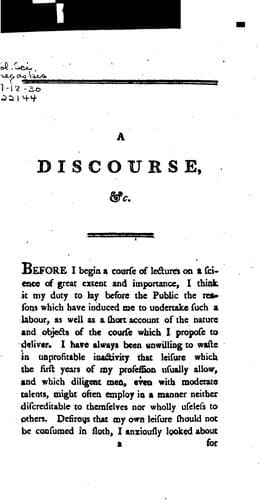
A Discourse on the Study of the Law of Nature and NationsMackintosh, James, Sir
Philosophy
A Discourse on the Study of the Law of Nature and Nations
Mackintosh, James, Sir
International law; Natural law
eloquence, but who is, if possible, still more admired by all competent
judges for his philosophy; a writer, of whom I may justly say, that he
was "_gravissimus et dicendi et intelligendi auctor et magister_;" that
I cannot refuse myself the gratification of quoting his words:--"The
science of jurisprudence, the pride of the human intellect, which, with
all its defects, redundancies, and errors, is the collected reason of
ages combining the principles of original justice with the infinite
variety of human concerns."[31]
I shall exemplify the progress of law, and illustrate those principles
of universal justice on which it is founded, by a comparative review of
the two greatest civil codes that have been hitherto formed--those of
Rome and of England;[32] of their agreements and disagreements, both in
general provisions, and in some of the most important parts of their
minute practice. In this part of the course, which I mean to pursue with
such detail as to give a view of both codes, that may perhaps be
sufficient for the purposes of the general student, I hope to convince
him that the laws of civilised nations, particularly those of his own,
are a subject most worthy of scientific curiosity; that principle and
system run through them even to the minutest particular, as really,
though not so apparently, as in other sciences, and applied to purposes
more important than in any other science. Will it be presumptuous to
express a hope, that such an inquiry may not be altogether an useless
introduction to that larger and more detailed study of the law of
England, which is the duty of those who are to profess and practise that
law.
In considering the important subject of criminal law it will be my duty
to found, on a regard to the general safety, the right of the magistrate
to inflict punishments, even the most severe, if that safety cannot be
effectually protected by the example of inferior punishments. It will be
a more agreeable part of my office to explain the temperaments which
Wisdom, as well as Humanity, prescribes in the exercise of that harsh
right, unfortunately so essential to the preservation of human society.
I shall collate the penal codes of different nations, and gather
together the most accurate statement of the result of experience with
respect to the efficacy of lenient and severe punishments; and I shall
endeavour to ascertain the principles on which must be founded both the
proportion and the appropriation of penalties to crimes.
Public-domain text, read in full here on John Shaqi.
Reviews
Reviews
No reviews yet
Be the first to share your thoughts on this work.
Join the Discussion
Join the discussion
Sign in to leave a comment or review.
Sign InorCreate an account