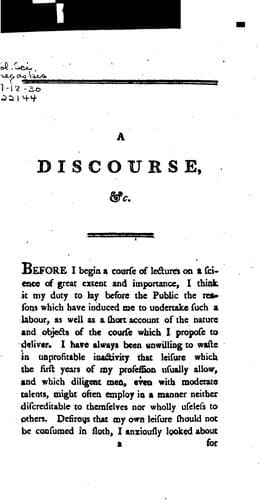
A Discourse on the Study of the Law of Nature and NationsMackintosh, James, Sir
Philosophy
A Discourse on the Study of the Law of Nature and Nations
Mackintosh, James, Sir
International law; Natural law
On the great questions of morality, of politics, and of municipal law,
it is the object of this science to deliver only those fundamental
truths of which the particular application is as extensive as the whole
private and public conduct of men; to discover those "fountains of
justice," without pursuing the "streams" through the endless variety of
their course. But another part of the subject is treated with greater
fulness and minuteness of application; namely, that important branch of
it which professes to regulate the relations and intercourse of states,
and more especially, both on account of their greater perfection and
their more immediate reference to use, the regulations of that
intercourse as they are modified by the usages of the civilised nations
of Christendom. Here this science no longer rests in general principles.
That province of it which we now call the law of nations, has, in many
of its parts, acquired among our European nations much of the precision
and certainty of positive law, and the particulars of that law are
chiefly to be found in the works of those writers who have treated the
science of which I now speak. It is because they have classed (in a
manner which seems peculiar to modern times) the duties of individuals
with those of nations, and established their obligation on similar
grounds, that the whole science has been called, "The Law of Nature and
Nations."
Whether this appellation be the happiest that could have been chosen
for the science, and by what steps it came to be adopted among our
modern moralists and lawyers,[3] are inquiries, perhaps, of more
curiosity than use, and which, if they deserve any where to be deeply
pursued, will be pursued with more propriety in a full examination of
the subject than within the short limits of an introductory discourse.
Names are, however, in a great measure arbitrary; but the distribution
of knowledge into its parts, though it may often perhaps be varied with
little disadvantage, yet certainly depends upon some fixed principles.
The modern method of considering individual and national morality as the
subjects of the same science, seems to me as convenient and reasonable
an arrangement as can be adopted. The same rules of morality which hold
together men in families, and which form families into commonwealths,
also link together these commonwealths as members of the great society
of mankind. Commonwealths, as well as private men, are liable to injury,
and capable of benefit, from each other; it is, therefore, their
interest as well as their duty to reverence, to practise, and to
enforce those rules of justice which control and restrain injury, which
regulate and augment benefit, which, even in their present imperfect
observance, preserve civilised states in a tolerable condition of
security from wrong, and which, if they could be generally obeyed, would
establish, and permanently maintain, the well-being of the universal
commonwealth of the human race.
Public-domain text, read in full here on John Shaqi.
Reviews
Reviews
No reviews yet
Be the first to share your thoughts on this work.
Join the Discussion
Join the discussion
Sign in to leave a comment or review.
Sign InorCreate an account