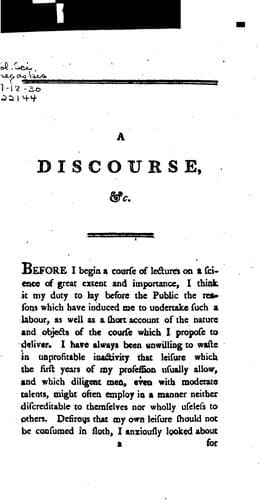
A Discourse on the Study of the Law of Nature and NationsMackintosh, James, Sir
Philosophy
A Discourse on the Study of the Law of Nature and Nations
Mackintosh, James, Sir
International law; Natural law
It is therefore with justice that one
part of this science has been called "_the natural law of individuals_,"
and the other "_the natural law of states_;" and it is too obvious to
require observation,[4] that the application of both these laws, of the
former as much as of the latter, is modified and varied by customs,
conventions, character, and situation. With a view to these principles,
the writers on general jurisprudence have considered states as moral
persons; a mode of expression which has been called a fiction of law,
but which may be regarded with more propriety as a bold metaphor, used
to convey the important truth, that nations, though they acknowledge no
common superior, and neither can nor ought to be subjected to human
punishment, are yet under the same obligations mutually to practise
honesty and humanity, which would have bound individuals, even if they
could be conceived ever to have subsisted without the protecting
restraints of government; if they were not compelled to the discharge of
their duty by the just authority of magistrates, and by the wholesome
terrors of the laws. With the same views this law has been styled, and
(notwithstanding the objections of some writers to the vagueness of the
language) appears to have been styled with great propriety, "the law of
nature." It may with sufficient correctness, or at least by an easy
metaphor, be called a "_law_," inasmuch as it is a supreme, invariable,
and uncontrollable rule of conduct to all men, of which the violation is
avenged by natural punishments, which necessarily flow from the
constitution of things, and are as fixed and inevitable as the order of
nature. It is the "_law of nature_," because its general precepts are
essentially adapted to promote the happiness of man, as long as he
remains a being of the same nature with which he is at present endowed,
or, in other words, as long as he continues to be man, in all the
variety of times, places, and circumstances, in which he has been known,
or can be imagined to exist; because it is discoverable by natural
reason, and suitable to our natural constitution; because its fitness
and wisdom are founded on the general nature of human beings, and not on
any of those temporary and accidental situations in which they may be
placed. It is with still more propriety, and indeed with the highest
strictness, and the most perfect accuracy, considered as a law, when,
according to those just and magnificent views which philosophy and
religion open to us of the government of the world, it is received and
reverenced as the sacred code, promulgated by the great Legislator of
the Universe for the guidance of his creatures to happiness, guarded and
enforced, as our own experience may inform us, by the penal sanctions
of shame, of remorse, of infamy, and of misery; and still farther
enforced by the reasonable expectation of yet more awful penalties in a
future and more permanent state of existence. It is the contemplation of
Public-domain text, read in full here on John Shaqi.
Reviews
Reviews
No reviews yet
Be the first to share your thoughts on this work.
Join the Discussion
Join the discussion
Sign in to leave a comment or review.
Sign InorCreate an account