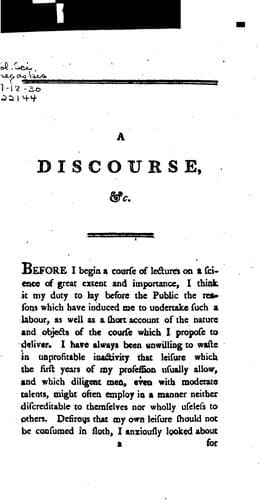
A Discourse on the Study of the Law of Nature and NationsMackintosh, James, Sir
Philosophy
A Discourse on the Study of the Law of Nature and Nations
Mackintosh, James, Sir
International law; Natural law
As to the _law of criminal proceeding_, my labour will be very easy; for
on that subject an English lawyer, if he were to delineate the model of
perfection, would find that, with few exceptions, he had transcribed the
institutions of his own country. The whole subject of my lectures, of
which I have now given the outline, may be summed up in, the words of
Cicero:--"Natura enim juris explicanda est nobis, eaque ab hominis
repetenda natura; considerandae leges quibus civitates regi debeant; tum
haec tractanda, quae composita sunt et descripta, jura et jussa populorum;
in quibus."--_Cic. de Leg._ lib. i. c. 5.
V. The next great division of the subject is the law of nations,
strictly and properly so called. I have already hinted at the general
principles on which this law is founded. They, like all the principles
of natural jurisprudence, have been more happily cultivated, and more
generally obeyed, in some ages and countries than in others; and, like
them, are susceptible of great variety in their application, from the
character and usages of nations. I shall consider these principles in
the gradation of those which are necessary to any tolerable intercourse
between nations; those which are essential to all well-regulated and
mutually advantageous intercourse; and those which are highly conducive
to the preservation of a mild and friendly intercourse between
civilised states. Of the first class, every understanding acknowledges
the necessity, and some traces of a faint reverence for them are
discovered even among the most barbarous tribes; of the second, every
well-informed man perceives the important use, and they have generally
been respected by all polished nations; of the third, the great benefit
may be read in the history of modern Europe, where alone they have been
carried to their full perfection. In unfolding the first and second
class of principles, I shall naturally be led to give an account of that
law of nations, which, in greater or less perfection, regulated the
intercourse of savages, of the Asiatic empires, and of the ancient
republics. The third brings me to the consideration of the law of
nations, as it is now acknowledged in Christendom. From the great extent
of the subject, and the particularity to which, for reasons already
given, I must here descend, it is impossible for me, within any moderate
compass, to give even an outline of this part of the course. It
comprehends, as every reader will perceive, the principles of national
independence, the intercourse of nations in peace, the privileges of
embassadors and inferior ministers, the commerce of private subjects,
the grounds of just war, the mutual duties of belligerent and neutral
powers, the limits of lawful hostility, the rights of conquest, the
faith to be observed in warfare, the force of an armistice, of safe
conducts and passports, the nature and obligation of alliances, the
means of negotiation, and the authority and interpretation of treaties
of peace.
Public-domain text, read in full here on John Shaqi.
Reviews
Reviews
No reviews yet
Be the first to share your thoughts on this work.
Join the Discussion
Join the discussion
Sign in to leave a comment or review.
Sign InorCreate an account