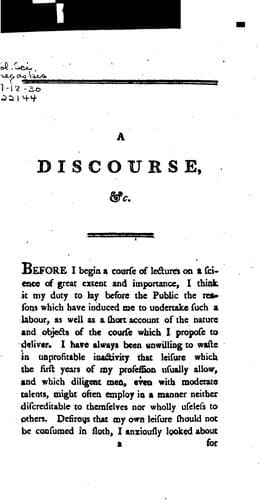
A Discourse on the Study of the Law of Nature and NationsMackintosh, James, Sir
Philosophy
A Discourse on the Study of the Law of Nature and Nations
Mackintosh, James, Sir
International law; Natural law
Information on this subject is scattered over an immense variety of
voluminous compilations; not accessible to every one, and of which the
perusal can be agreeable only to very few. Yet so much of these treaties
has been embodied into the general law of Europe, that no man can be
master of it who is not acquainted with them. The knowledge of them is
necessary to negotiators and statesmen; it may sometimes be important
to private men in various situations in which they may be placed; it is
useful to all men who wish either to be acquainted with modern history,
or to form a sound judgment on political measures. I shall endeavour to
give such an abstract of it as may be sufficient for some, and a
convenient guide for others in the farther progress of their studies.
The treaties, which I shall more particularly consider, will be those of
Westphalia, of Oliva, of the Pyrenees, of Breda, of Nimeguen, of
Ryswick, of Utrecht, of Aix-la-Chapelle, of Paris (1763), and of
Versailles (1783). I shall shortly explain the other treaties, of which
the stipulations are either alluded to, confirmed, or abrogated in those
which I consider at length. I shall subjoin an account of the diplomatic
intercourse of the European powers with the Ottoman Porte, and with
other princes and states who are without the pale of our ordinary
federal law; together with a view of the most important treaties of
commerce, their principles, and their consequences.
As an useful appendix to a practical treatise on the law of nations,
some account will be given of those tribunals which in different
countries of Europe decide controversies arising out of that law; of
their constitution, of the extent of their authority, and of their modes
of proceeding; more especially of those courts which are peculiarly
appointed for that purpose by the laws of Great Britain.
Though the course, of which I have sketched the outline, may seem to
comprehend so great a variety of miscellaneous subjects, yet they are
all in truth closely and inseparably interwoven. The duties of men, of
subjects, of princes, of law-givers, of magistrates, and of states, are
all parts of one consistent system of universal morality. Between the
most abstract and elementary maxim of moral philosophy, and the most
complicated controversies of civil or public law, there subsists a
connexion which it will be the main object of these lectures to trace.
The principle of justice, deeply rooted in the nature and interest of
man, pervades the whole system, and is discoverable in every part of it,
even to its minutest ramification in a legal formality, or in the
construction of an article in a treaty.
Public-domain text, read in full here on John Shaqi.
Reviews
Reviews
No reviews yet
Be the first to share your thoughts on this work.
Join the Discussion
Join the discussion
Sign in to leave a comment or review.
Sign InorCreate an account