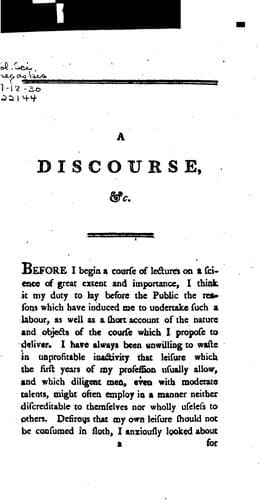
A Discourse on the Study of the Law of Nature and Nations — John Shaqi
A Discourse on the Study of the Law of Nature and NationsMackintosh, James, Sir
Philosophy
A Discourse on the Study of the Law of Nature and Nations
Mackintosh, James, Sir
International law; Natural law
I know not whether a philosopher ought to confess, that in his inquiries
after truth he is biased by any consideration; even by the love of
virtue. But I, who conceive that a real philosopher ought to regard
truth itself chiefly on account of its subserviency to the happiness of
mankind, am not ashamed to confess, that I shall feel a great
consolation at the conclusion of these lectures, if, by a wide survey
and an exact examination of the conditions and relations of human
nature, I shall have confirmed but one individual in the conviction,
that justice is the permanent interest of all men, and of all
commonwealths. To discover one new link of that eternal chain by which
the Author of the universe has bound together the happiness and the duty
of his creatures, and indissolubly fastened their interests to each
other, would fill my heart with more pleasure than all the fame with
which the most ingenious paradox ever crowned the most eloquent sophist.
I shall conclude this Discourse in the noble language of two great
orators and philosophers, who have, in a few words, stated the
substance, the object, and the result of all morality, and politics, and
law.
"Nihil est quod adhuc de republica putem dictum, et quo possim longius
progredi, nisi sit confirmatum, non modo falsum esse illud, sine injuria
non posse, sed hoc verissimum, sine summa justitia rempublicam regi non
posse."--_Cic. Frag._ lib. ii. _de Repub._
"Justice is itself the great standing policy of civil society, and any
eminent departure from it, under any circumstances, lies under the
suspicion of being no policy at all."--_Burke's Works_, vol. iii. p.
207.
FOOTNOTES
[1] See "A Syllabus of Lectures on the Law of England, to be delivered
in Lincoln's-Inn Hall by M. Nolan, Esq." London, 1796.
[2] I have not been deterred by some petty incongruity of metaphor from
quoting this noble sentence. Mr. Hume had, perhaps, this sentence in his
recollection, when he wrote a remarkable passage of his works. See
Hume's Essays, vol. ii. p. 352. ed. Lond. 1788.
Public-domain text, read in full here on John Shaqi.
Reviews
Reviews
No reviews yet
Be the first to share your thoughts on this work.
Join the Discussion
Join the discussion
Sign in to leave a comment or review.
Sign InorCreate an account