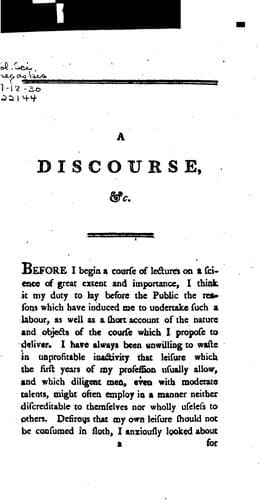
A Discourse on the Study of the Law of Nature and NationsMackintosh, James, Sir
Philosophy
A Discourse on the Study of the Law of Nature and Nations
Mackintosh, James, Sir
International law; Natural law
[3] The learned reader is aware that the "jus naturae" and "jus gentium"
of the Roman lawyers are phrases of very different import from the
modern phrases, "law of nature" and "law of nations." "Jus naturale,"
says Ulpian, "est quod natura omnia animalia docuit." D. I. I. I. 3.
"Quod naturalis ratio inter omnes homines constituit, id que apud omnes
peraeque custoditur vocaturque jus gentium." D. I. I. 9. But they
sometimes neglect this subtle distinction--"Jure naturali quod
appellatur jus gentium." I. 2. I. II. _Jus feciale_ was the Roman term
for our law of nations. "Belli quidem aequitas sanctissime populi Rom.
feciali jure perscripta est." Off. I. II. Our learned civilian Zouch has
accordingly entitled his work, "De Jure Feciali, sive de _Jure inter
Gentes_." The Chancellor D'Aguesseau, probably without knowing the work
of Zouch, suggested that this law should be called, "_Droit entre les
Gens_," (Oeuvres, tom. ii. p. 337.) in which he has been followed by a
late ingenious writer, Mr. Bentham, Princ. of Morals and Pol. p. 324.
Perhaps these learned writers do employ a phrase which expresses the
subject of this law with more accuracy than our common language; but I
doubt whether innovations in the terms of science always repay us by
their superior precision for the uncertainty and confusion which the
change occasions.
[4] This remark is suggested by an objection of _Vattel_, which is more
specious than solid. See his Prelim. Sec. 6.
[5] "Est quidem vera lex, recta ratio, _naturae congruens_, diffusa in
omnes, constans, sempiterna, quae vocet ad officium jubendo, vetando a
fraude deterreat, quae tamen neque probos frustra jubet aut vetat, neque
improbos jubendo aut vetando movet. Huic legi neque obrogari fas est,
neque derogari ex hac aliquid licet, neque tota abrogari potest. Nec
vero aut per senatum aut per populum solvi hac lege possumus. Neque est
quaerendus explanator aut interpres ejus alius. Nec erit alia lex Romae,
alia Athenis, alia nunc, alia posthac, sed et omnes gentes et omni
tempore una lex et sempiterna, et immortalis continebit, unusque erit
communis quasi magister et imperator omnium Deus. Ille legis hujus
inventor, disceptator, lator, cui qui non parebit _ipse se fugiet et
naturam hominis aspernabitur_, atque hoc ipso luet maximas poenas
etiamsi caetera supplicia quae putantur effugerit."--_Fragm._ lib. iii.
_Cicer. de Republ. apud Lactant_.
It is impossible to read such precious fragments without deploring the
loss of a work which, for the benefit of all generations, _should_ have
been immortal.
[6] "Age vero urbibus constitutis ut fidem colere et justitiam retinere
discerent et aliis parere sua voluntate consuescerent, ac non modo
labores excipiendos communis commodi causa sed etiam vitam amittendam
existimarent; qui tandem fieri potuit nisi homines ea quae ratione
invenissent eloquentia persuadere potuissent."--_Cic. de Inv. Rhet._
lib. i. in proem.
[7] [Greek: Dichaiomata tot polimot.]
Public-domain text, read in full here on John Shaqi.
Reviews
Reviews
No reviews yet
Be the first to share your thoughts on this work.
Join the Discussion
Join the discussion
Sign in to leave a comment or review.
Sign InorCreate an account