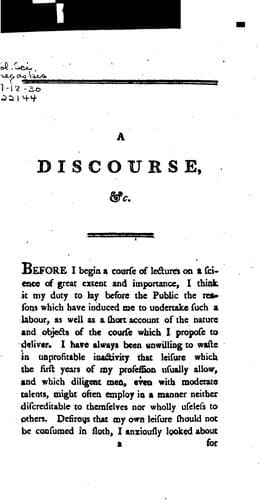
A Discourse on the Study of the Law of Nature and NationsMackintosh, James, Sir
Philosophy
A Discourse on the Study of the Law of Nature and Nations
Mackintosh, James, Sir
International law; Natural law
vindicate myself from presumption in attempting a subject which has been
already handled by so many masters. For the purpose of that vindication
it will be necessary to sketch a very short and slight account (for such
in this place it must unavoidably be) of the progress and present state
of the science, and of that succession of able writers who have
gradually brought it to its present perfection.
We have no Greek or Roman treatise remaining on the law of nations. From
the title of one of the lost works of Aristotle, it appears that he
composed a treatise on the laws of war,[7] which, if we had the good
fortune to possess it, would doubtless have amply satisfied our
curiosity, and would have taught us both the practice of the ancient
nations and the opinions of their moralists, with that depth and
precision which distinguish the other works of that great philosopher.
We can now only imperfectly collect that practice and those opinions
from various passages which are scattered over the writings of
philosophers, historians, poets, and orators. When the time shall arrive
for a more full consideration of the state of the government and manners
of the ancient world, I shall be able, perhaps, to offer satisfactory
reasons why these enlightened nations did not separate from the general
province of ethics that part of morality which regulates the intercourse
of states, and erect it into an independent science. It would require a
long discussion to unfold the various causes which united the modern
nations of Europe into a closer society; which linked them together by
the firmest bands of mutual dependence, and which thus, in process of
time, gave to the law that regulated their intercourse greater
importance, higher improvement, and more binding force. Among these
causes we may enumerate a common extraction, a common religion, similar
manners, institutions, and languages; in earlier ages the authority of
the See of Rome, and the extravagant claims of the imperial crown; in
later times the connexions of trade, the jealousy of power, the
refinement of civilization, the cultivation of science, and, above all,
that general mildness of character and manners which arose from the
combined and progressive influence of chivalry, of commerce, of
learning, and of religion. Nor must we omit the similarity of those
political institutions which, in every country that had been over-run by
the Gothic conquerors, bore discernible marks (which the revolutions of
succeeding ages had obscured, but not obliterated) of the rude but bold
and noble outline of liberty that was originally sketched by the hand of
these generous barbarians. These and many other causes conspired to
unite the nations of Europe in a more intimate connexion and a more
constant intercourse, and of consequence made the regulation of their
intercourse more necessary, and the law that was to govern it more
important. In proportion as they approached to the condition of
Public-domain text, read in full here on John Shaqi.
Reviews
Reviews
No reviews yet
Be the first to share your thoughts on this work.
Join the Discussion
Join the discussion
Sign in to leave a comment or review.
Sign InorCreate an account