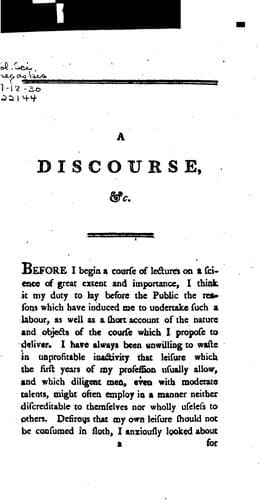
A Discourse on the Study of the Law of Nature and NationsMackintosh, James, Sir
Philosophy
A Discourse on the Study of the Law of Nature and Nations
Mackintosh, James, Sir
International law; Natural law
the law of nature under this full, mature, and perfect idea of its high
origin and transcendent dignity, that called forth the enthusiasm of the
greatest men, and the greatest writers of ancient and modern times, in
those sublime descriptions, where they have exhausted all the powers of
language, and surpassed all the other exertions, even of their own
eloquence, in the display of the beauty and majesty of this sovereign
and immutable law. It is of this law that Cicero has spoken in so many
parts of his writings, not only with all the splendour and copiousness
of eloquence, but with the sensibility of a man of virtue; and with the
gravity and comprehension of a philosopher.[5] It is of this law that
Hooker speaks in so sublime a strain:--"Of law, no less can be said,
than that her seat is the bosom of God, her voice the harmony of the
world; all things in heaven and earth do her homage, the very least as
feeling her care, the greatest as not exempted from her power; both
angels and men, and creatures of what condition soever, though each in
different sort and manner, yet all with uniform consent admiring her as
the mother of their peace and joy."--_Eccles. Pol._ book i. in the
conclusion.
Let not those, who, to use the language of the same Hooker, "talk of
truth," without "ever sounding the depth from whence it springeth,"
hastily take it for granted, that these great masters of eloquence and
reason were led astray by the specious delusions of mysticism, from the
sober consideration of the true grounds of morality in the nature,
necessities, and interests of man. They studied and taught the
principles of morals; but they thought it still more necessary, and more
wise, a much nobler task, and more becoming a true philosopher, to
inspire men with a love and reverence for virtue.[6] They were not
contented with elementary speculations. They examined the foundations of
our duty, but they felt and cherished a most natural, a most seemly, a
most rational enthusiasm, when they contemplated the majestic edifice
which is reared on these solid foundations. They devoted the highest
exertions of their mind to spread that beneficent enthusiasm among men.
They consecrated as a homage to virtue the most perfect fruits of their
genius. If these grand sentiments of "the good and fair" have sometimes
prevented them from delivering the principles of ethics with the
nakedness and dryness of science, at least, we must own that they have
chosen the better part; that they have preferred virtuous feeling to
moral theory; and practical benefit to speculative exactness. Perhaps
these wise men may have supposed that the minute dissection and anatomy
of Virtue might, to the ill-judging eye, weaken the charm of her
beauty. It is not for me to attempt a theme which has perhaps been
exhausted by these great writers. I am indeed much less called upon to
display the worth and usefulness of the law of nations, than to
Public-domain text, read in full here on John Shaqi.
Reviews
Reviews
No reviews yet
Be the first to share your thoughts on this work.
Join the Discussion
Join the discussion
Sign in to leave a comment or review.
Sign InorCreate an account