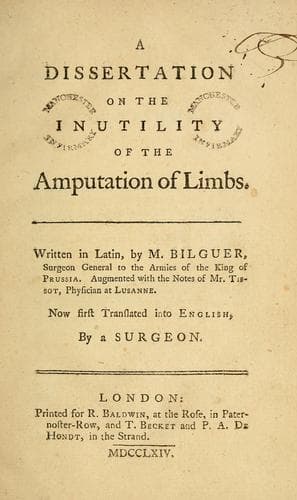
A dissertation on the inutility of the amputation of limbs — John Shaqi
A dissertation on the inutility of the amputation of limbsBilguer, Johann Ulrich
History
A dissertation on the inutility of the amputation of limbs
Bilguer, Johann Ulrich
Amputation -- Early works to 1800
When the incisions are made, if the neighbouring parts appear somewhat
tainted, we must, by gentle compression, squeeze out the corrupted
humour which may harbour there, and wipe it off with a bit of soft
linnen rag. Afterwards, whether it may have been necessary to extract,
either with the fingers, a scalpel, or with the instrument called a
myrtle leaf[8], any bony splinters too much detached from the substance
of the bone itself to hope for a re-union, a circumstance which often
requires a considerable dilatation of the fleshy parts; or whether
the bones appear carious, or spoiled in any other shape; or, lastly,
whether we may have been obliged to make deep incisions, even to
the bone: In all these cases, we must at first employ such external
applications as are proper for the bones, and for the soft parts that
have a tendency to mortification, although they may have discharged a
sufficient quantity of blood during these operations.
The bone, whether the periosteum be sound or destroyed, must be dressed
with the following medicine: _Of frankincense, mastick, sarcocolla and
myrrh finely pounded, true balsam of Peru, and genuine essential oil
of cloves, of each equal parts; of balsam of Fioraventi, as much as
may, in mixing all the ingredients over a very gentle fire, form a thin
liniment_; which must be warmed when used, and which must be poured
plentifully into the wounds I am speaking of, so that the bone may be
well moistened therewith.
This medicine is of service in all cases where the bone is affected.
When the bone is covered with it, some dry lint may be laid over it,
and the soft parts dressed by sprinkling upon this lint a powder
composed of _an ounce of myrrh finely pounded, half an ounce of sal
ammoniac, camphor and nitre, each a dram_. After the first layer of
lint is thus covered, fresh lint must be applied, and again sprinkled
with the powder, till in this manner the cavity of the wound is quite
filled up with alternate layers of lint, and this vulnerary powder.
FOOTNOTES:
[8] See Dionis's surgery, page 18. 4th edition.
SECT. XI.
If the bone is not affected, or the periosteum laid bare, the balsam or
thin liniment may be omitted. And the dressings may only consist of the
layers of dry lint and vulnerary powder applied alternately.
SECT. XII.
Besides the dressings I have mentioned (§ X. and § XI.) for these
kinds of wounds, we must likewise make slight scarifications upon the
neighbouring parts, and sprinkle them with the powder; after this
treatment, embrocate all the sores with oil of turpentine, and then
lightly bandage up the whole with plain linnen cloth, which must be
kept moistened, night and day, with warm fomentations.
SECT. XIII.
Public-domain text, read in full here on John Shaqi.
Reviews
Reviews
No reviews yet
Be the first to share your thoughts on this work.
Join the Discussion
Join the discussion
Sign in to leave a comment or review.
Sign InorCreate an account