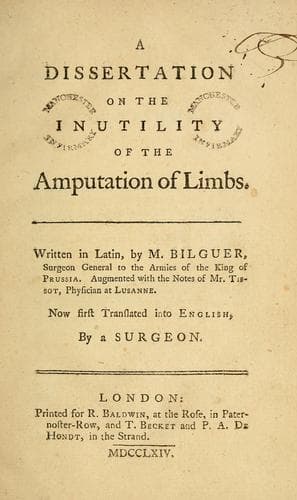
A dissertation on the inutility of the amputation of limbsBilguer, Johann Ulrich
History
A dissertation on the inutility of the amputation of limbs
Bilguer, Johann Ulrich
Amputation -- Early works to 1800
After these incisions are made, we must carefully examine how far the
part which is absolutely mortified, and which it is impossible to
restore to life, may reach. This may be distinguished by the stench
which exhales from it, by its change of colour, and want of feeling.
These mortified parts ought immediately to be separated from the sound,
and removed by means of a bistory in the same manner as one muscle is
divided from another in an anatomical dissection. In order to do this,
the dead flesh must be cut through cross-ways, which puts the patient
to no kind of pain. But care must be taken in this operation, not to
separate such parts as may be somewhat affected by the mortification,
yet not totally corrupted, as it often happens, after the removal of
what is entirely dead, that they recover, by proper assistance, their
natural state.
In making these incisions, we should take all imaginable care, as I
have already remarked, not to wound the larger blood vessels or more
considerable nerves; for this purpose, the gangrened parts which
lie near them, should be separated with great caution: It is even
better to leave behind a small portion of the mortified flesh which
may adhere to them, and to trust for its separation to the ensuing
dressings, which they will not fail to accomplish. The reason for this
rule is, that we often see the vessels remain sufficiently sound,
while the other parts are very much corrupted. We find for example,
in the arm, near the joint of the elbow, near the wrist, and even in
the lower extremities, the vessels intire, although the mortification
of the parts which surround them be so considerable, as to oblige us
to make our incisions to the bone; and it is these vessels, after the
extirpation of the dead parts, that must keep up life in those which
remain: We ought to preserve the greatest number we can, not only of
the larger vessels, but even of the smaller ones: It was with a view to
this particular, that I recommended not to make our incisions rashly,
but with a good deal of caution, both with respect to the place where
they were made, their direction and their distance. In operating with
this circumspection, we shall avoid incurring the censure of Platnerus,
who remarks, that we ought not to separate the dead from the sound
parts with violence, “Because,” says he, “incisions which cause an
effusion of blood, often renew the inflammation.” Now in my method,
there is neither any violence, nor incisions attended with blood.
SECT. X.
Public-domain text, read in full here on John Shaqi.
Reviews
Reviews
No reviews yet
Be the first to share your thoughts on this work.
Join the Discussion
Join the discussion
Sign in to leave a comment or review.
Sign InorCreate an account