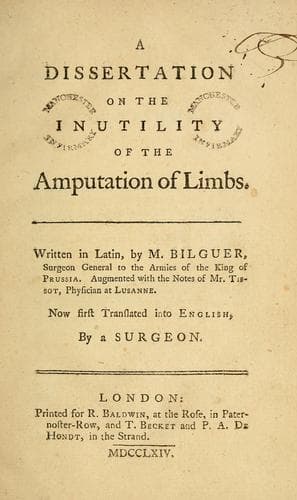
A dissertation on the inutility of the amputation of limbs — John Shaqi
A dissertation on the inutility of the amputation of limbsBilguer, Johann Ulrich
History
A dissertation on the inutility of the amputation of limbs
Bilguer, Johann Ulrich
Amputation -- Early works to 1800
This medicine is principally of service in cases where, on account
of the proximity of the bones, we would not chuse too plentiful a
suppuration.
FOOTNOTES:
[14] This precept, of which the very reverse is but too frequently
practised, is of very great consequence: It is founded upon this, that
a discharge of blood proves that an incision has reached the quick;
now every such incision produces an inflammation, which retards the
suppuration already begun, and hence we interrupt this operation of
nature which we meant to promote, and, as it is the means of preventing
a mortification, whatever interrupts it contributes to the disease: It
cannot, therefore, be too often repeated, that in general, incisions
which cause a discharge of blood, ought never to be practised after a
suppuration is begun. TISSOT.
SECT. XVII.
It was probably by some such application, that S** G**** cured a man
whose arm was mortified, and whom the physicians and surgeons had
given up; a cure which appears to me much less wonderful than what
is imagined. The physicians and surgeons despaired of his recovery,
and quitted him, because he would not submit to amputation, at the
very time when, doubtless, the separation of the sound and mortified
parts began to take place, owing either to the force of nature or the
medicines they had administered, and when granulations of new flesh
began to shoot. It was easy for S** G****, called in at this instant,
to effect a cure, by means of his quieting powders and balsam. What is
most astonishing in this case, and deserves at the same time to excite
our indignation, is the obstinacy and the cruelty of the physicians;
but they were sufficiently punished for it.
SECT. XVIII.
This is not the only instance of patients in whose cases physicians
and surgeons have pronounced amputation to be unavoidable, and who,
upon their refusing to submit to it, have afterwards been cured by very
simple treatment. This ought to be a lesson for us never to be too
precipitate in having recourse to this operation.
But what must be done, they will say, when every medicine has failed?
Is it not better, in such a situation, to try a doubtful remedy, as
Celsus expresses it, than to do nothing?
Public-domain text, read in full here on John Shaqi.
Reviews
Reviews
No reviews yet
Be the first to share your thoughts on this work.
Join the Discussion
Join the discussion
Sign in to leave a comment or review.
Sign InorCreate an account