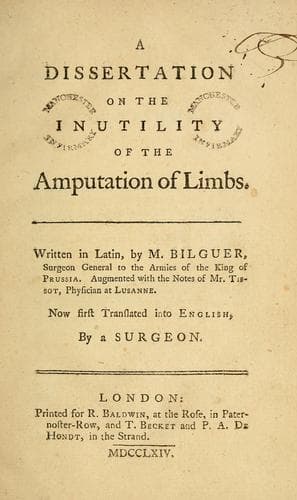
A dissertation on the inutility of the amputation of limbs — John Shaqi
A dissertation on the inutility of the amputation of limbsBilguer, Johann Ulrich
History
A dissertation on the inutility of the amputation of limbs
Bilguer, Johann Ulrich
Amputation -- Early works to 1800
As what is called a doubtful remedy, is for the most part no remedy at
all, I look upon such an argument as very fallacious; I shall explain,
what I think on this point. Every mortification is the consequence
either of some internal morbid cause, or an external accident. In the
first case, amputation can be of no service while the morbid cause
remains; and who can hope, in so short a time, to remove a consumption,
the scurvy, a decay from old age, a dropsy, or cachexy? And if these
cannot be removed before amputation, it is to very little purpose to
operate on the sound part, as it would only be killing the patient. Is
there a physician or surgeon but would conclude he occasioned the death
of a dropsical person, were he to cut his mortified leg off above the
knee? What is true in a dropsical case, is equally so with respect to
others: To amputate, is only to give needless pain, and to accelerate
the patient's death. It may be further asked, Must we then in such a
situation intirely abandon the patient? I answer, No; but we ought to
direct our efforts against the morbid cause, and at the same time,
employ the most effectual applications externally, lopping off whatever
is absolutely mortified, without cutting to the quick, lest the pain,
and other accidents which are the consequence of such incisions, should
hasten death. After this treatment, the remainder may be left to
nature, assisted with the most efficacious medicines, internal as well
as external; and if the patient dies, we may rest satisfied that the
disease was beyond the resources of art.
FOOTNOTES:
[15][15] I hardly ever knew any old officers who have not been witnesses
of some examples of this kind; and I have seen several people who have
themselves been in such a situation.
SECT. XIX.
When a mortification in a healthy constitution is the consequence of
an external accident, the point is not so easily determined; I will
venture, nevertheless, to remove the difficulty.
It must first be inquired into, if the ailment has been properly
treated at the begining, and if sufficient care has been taken with
respect to the cause. If there appears any default in these points, we
must first endeavour to repair it, before we think of amputation. If,
on the contrary, the treatment has been judicious, we must examine if
the mortification continues to spread, or if it be stopt, and its edges
begin to discover themselves.
Public-domain text, read in full here on John Shaqi.
Reviews
Reviews
No reviews yet
Be the first to share your thoughts on this work.
Join the Discussion
Join the discussion
Sign in to leave a comment or review.
Sign InorCreate an account