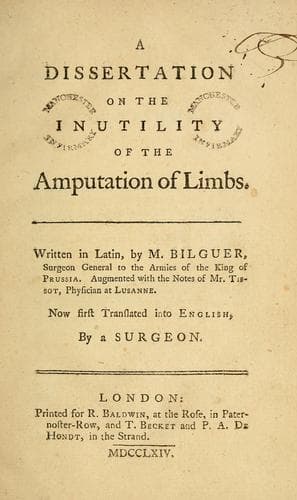
A dissertation on the inutility of the amputation of limbsBilguer, Johann Ulrich
History
A dissertation on the inutility of the amputation of limbs
Bilguer, Johann Ulrich
Amputation -- Early works to 1800
If the rottenness of the bone demonstrates that the limb cannot be
saved, which almost always happens, if the patient has been improperly
treated, we must amputate, if the strength of the patient be sufficient
to support this dreadful expedient, and amputate on the sound parts.
It is true, that amputation in this case is a doubtful remedy, but
nevertheless as there is no other, and as there is no symptom in the
patient that forbids its use, it is a remedy. If the patient be weak,
the case is desperate, as he is not able to support the operation
on the sound parts, and as nature is not in a condition to effect a
separation of the dead from the live flesh, if only the mortified part
be cut off.
In so dangerous a case, the method I would take, would be, after
providing against any hemorrhage of the larger vessels by a proper
ligature, to lop off all the gangrened useless mass, not actually
through the quick itself, but very near it; afterwards I would
endeavour to stop the progress of the infection by internal medicines
and suitable dressings. I would support his strength by a proper
regimen; if it increases, we may be sure a separation of the soft parts
that are mortified will ensue naturally; after which, it will be easy
to saw off the little stump of dead bone that was left. The wound may
then be cicatrised, by means of epulotic applications, and such as we
have recommended for bones when laid bare, § X.
This practice is not only conformable to sound reason, but what is
more, it is confirmed by repeated experience; since we find among the
collectors of observations, but few instances of amputation succeeding,
when it was performed while a mortification continued to gain ground,
or while the patient was feverish; but a much greater number of
successful cases, when amputation was performed late, and when the
disease had abated naturally: A variety of examples may be seen in the
work of Mr. Schaarschmid[19], which I have already quoted.
It will, perhaps, be objected to me, that I am inconsistent with
myself, since I have just proposed one method, and actually follow
another; but this objection will vanish, if it be considered in the
first place, that if a person has been thus judiciously treated
from the beginning, and does not recover, a cure will almost never
be effected, after the cruel expedient of amputation. In the second
place, that all those who are under a necessity of submitting to this
dangerous operation, on account of their having neglected themselves,
or having been unskilfully treated, have no reason to complain of the
art, or of those who understand it, but of their own negligence, or of
the ignorance of those into whose hands they have had the misfortune
to fall. And in the third place, that in opposing amputation on the
sound parts, and in testifying my abhorrence against the needless pain
which accompanies it, I do not at all condemn the amputation of what is
absolutely mortified.
Public-domain text, read in full here on John Shaqi.
Reviews
Reviews
No reviews yet
Be the first to share your thoughts on this work.
Join the Discussion
Join the discussion
Sign in to leave a comment or review.
Sign InorCreate an account