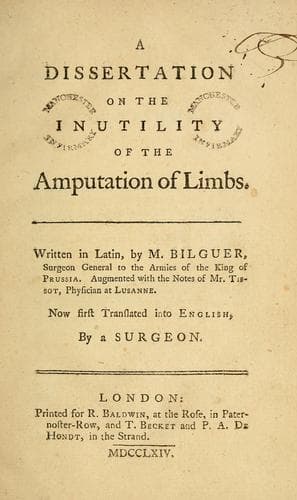
A dissertation on the inutility of the amputation of limbsBilguer, Johann Ulrich
History
A dissertation on the inutility of the amputation of limbs
Bilguer, Johann Ulrich
Amputation -- Early works to 1800
If it continues to spread, it is improper to amputate, for several
reasons. In the first place, because the whole habit is in a bad
state, and there must be a fever and general inflammation, which would
be greatly increased by an operation which, of itself, is sufficient
to bring on the death of the healthiest man. In the second place,
amputation cannot be performed on the sound part, in the manner as is
generally imagined, as the infection is very often more deeply seated
than it appears to be: We may judge of this by observing what happens
very frequently in whitlows of a bad kind, where the matter quickly
insinuates itself along the arm, and is pent up there, inflaming
sometimes even the axillary glands; as an inflammation of the toes,
in a short time, brings on that of the glands in the groin: Thus
the disease having taken root in the place where the operation is
performed, would of course be increased by the ligatures, which are
indispensably necessary in this operation, unless we would suffer the
patient to perish by an hemorrhage. In such a case then, amputation
is not a dubious remedy, but it is no remedy at all[16]; and if the
patient sometimes does escape, it must be acknowledged that nature has
effected the cure; that she has got the better both of the disease and
of the bad treatment, and has thus overcome a double enemy.
It is evident, from what I have said, that while the mortification
gains ground, the method I have proposed, § VII. XVI. should be
followed. When its progress is stopt, it must be considered whether
the limb can be preserved or not. We may entertain hopes[17] of its
preservation, if all the corrupted parts cast off, and the sound parts,
and even the bones, begin to produce granulations of new flesh. I
cannot here omit remarking, that Mr. Haller's late experiments, which
prove to the satisfaction of many eminent anatomists, the insensibility
of the periosteum, render the sign of a mortification derived from such
insensibility very doubtful. My experiments on this subject agree with
his, excepting in this, that I always found the pericranium extremely
sensible[18]. Whatever weight may be laid on these experiments, this
consequence may at least be deduced from them, that we ought not
immediately to conclude that the bones and periosteum are affected,
because we prick, cut or tear the periosteum without giving pain; nor,
in like manner, from this symptom, ought we to neglect the medicines
indicated § VII. XVI.
Public-domain text, read in full here on John Shaqi.
Reviews
Reviews
No reviews yet
Be the first to share your thoughts on this work.
Join the Discussion
Join the discussion
Sign in to leave a comment or review.
Sign InorCreate an account