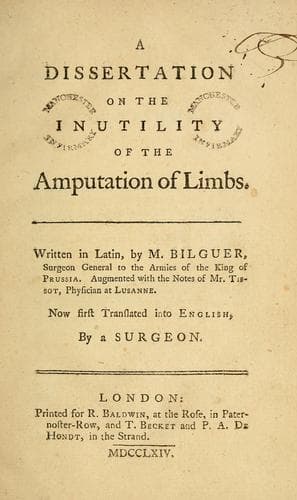
A dissertation on the inutility of the amputation of limbsBilguer, Johann Ulrich
History
A dissertation on the inutility of the amputation of limbs
Bilguer, Johann Ulrich
Amputation -- Early works to 1800
I have treated hitherto of limbs intirely divided; I shall now examine
what ought to be done, when a ball, or any piece of iron or lead, has
so greatly injured the bones of the hand, arm, foot or leg, that,
although they are not quite broke through, and the part suspended by
a small portion of flesh and skin, as in the former case, § XXI. are
nevertheless so much shattered that the part may be moved any way,
and seems to hang useless. In these circumstances, we must dilate
the aperture made by the ball, or by whatever body has inflicted the
wound, and separate the flesh from the bone; in a word, we must make
the wound sufficiently large, in order to lay the shattered bones bare,
especially where they are broken across, that they may be more easily
managed by the fingers; then as many splinters as possible must be
extracted, as well as the ball and other extraneous bodies. If there
be the apertures of two balls, they must both be treated in the same
manner: When it is expedient to make counter openings, they may be
made indifferently, whether there be one or two openings, and these
artificial wounds must be made sufficiently large, to admit of the
extracting of the splinters and other extraneous matters. In other
respects, the dressings must be the same as § XXI. Every time they
are renewed, the splinters must be extracted as they become loose and
can be easily separated; if there be some large fragments which must
be removed, we may begin by dividing them from the fleshy parts, then
sawing them through with a very small saw, whose blade is extremely
thin and narrow, crooked or straight, in order to push it from above
downwards, or from below upwards, or sideways, as may be convenient.
This method answered so well with me for the bones of the leg and arm,
that I have often, in this manner, separated pieces three or four
inches in length, and even longer. As for the smaller bones, such as
those of the hands or feet, I have divided and extracted them entire,
when they were broken and shattered, and sometimes even when they were
not.
If a bullet has penetrated into the cavity of a bone, such bone must be
laid bare, either on the side by which the bullet has made its way, or
on the opposite one; afterwards it must be pierced with two or three
trepans, and the extraneous body, and the shivers of the bone extracted.
If the bullet has made its way into one side of the joint of the elbow
or knee, and by that means shattered several bones at one stroke, I
treat it in the same manner, dilating the wound and extracting the
splinters as before, and the wounds get well like the others.
I cured a patient who had been wounded by a bullet which entered the
cavity of the os humeri; he would not consent to have it extracted,
which did not however prevent his recovery, nor has he felt any further
inconvenience from it than a small protuberance on the place where the
ball is still lodged[24].
Public-domain text, read in full here on John Shaqi.
Reviews
Reviews
No reviews yet
Be the first to share your thoughts on this work.
Join the Discussion
Join the discussion
Sign in to leave a comment or review.
Sign InorCreate an account