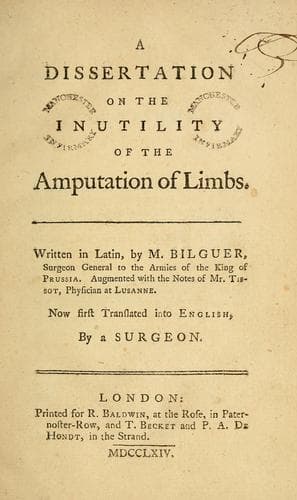
A dissertation on the inutility of the amputation of limbsBilguer, Johann Ulrich
History
A dissertation on the inutility of the amputation of limbs
Bilguer, Johann Ulrich
Amputation -- Early works to 1800
It will perhaps be asked, if it be possible that a ball should enter
the cavity of a bone without splitting or breaking it, as seems to have
happened in the case I have just mentioned? and where that circumstance
will appear still less feasible, when I affirm, that the bones of
this man were strong, hard and compact; and that on some occasions,
fissures and the other accidents of bones, I have been treating of,
are often the consequences of slight wounds, as of more considerable
ones. But be that as it may, I treat these kinds of wounds in this
manner: I dress the bone partly with dry lint, and partly with balsamic
essences, and sometimes I throw in injections: I apply a digestive to
the fleshy parts, and moisten all the dressings with spirit of wine,
as in § XXI. I check the suppuration a little, preserving, as much as
possible, the boney fragments which adhere together, so as to leave
room to hope for their coalition, sustaining them in their natural
position, and covering them again as much as possible with the flesh
and skin: If there be any pointed splinters, I endeavour to promote
their separation by proper applications, such as the balsamic essences,
and different powders, particularly that mentioned § X.
I fix the limb in its natural position, suspending the arm in a sling,
or half-cylinder adapted for the purpose. For the leg, I use Mr.
Petit's machine, or splints, made of wooden rods covered with straw,
and wrapped up in linnen cloth; and in the dressings, my chief aim is
to keep them sufficiently tight above and below the wound, to promote
the consolidation of the larger pieces of bone, by keeping them firm
in their places, and preventing the re-absorption of pus. The diet and
medicines are the same as in § XXII. By this method a very great number
of wounded men have been restored to health, in two, three or four
months; and some not before the expiration of eight. My observations
confirm those of Horstius, who remarks, that a man who has lost a great
portion of the tibia and fibula, may nevertheless, after his cure, walk
with ease, and halt but very little[25].
FOOTNOTES:
[24] He was a soldier in the guards, and is doing his duty in the field
at the very time I write this.
[25] HORSTII _observationes medicæ_, part ii. 1. 4. obs. 10. Mr. de
Frengler, captain lieutenant in the regiment of Anhalt Bernbourg, is an
instance of a most successful cure of a wound of the leg of this kind.
In the sequel of this dissertation may be seen, several striking cases
of an extraordinary loss of substance in the bones being again repaired.
SECT. XXV.
Public-domain text, read in full here on John Shaqi.
Reviews
Reviews
No reviews yet
Be the first to share your thoughts on this work.
Join the Discussion
Join the discussion
Sign in to leave a comment or review.
Sign InorCreate an account