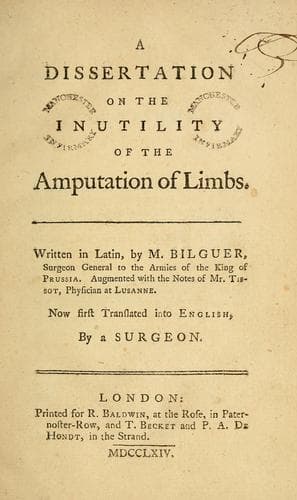
A dissertation on the inutility of the amputation of limbs — John Shaqi
A dissertation on the inutility of the amputation of limbsBilguer, Johann Ulrich
History
A dissertation on the inutility of the amputation of limbs
Bilguer, Johann Ulrich
Amputation -- Early works to 1800
[34] I am of opinion, that if one had the misfortune of being reduced
to the necessity of chusing between amputating at the upper part of
the thigh, or at the articulation itself, one reason for prefering the
latter, would be the greater ease there is in stopping the hemorrhage
of the crural artery.
A surgeon and anatomist, who has been in repute, observes, _That an
hemorrhage of the crural artery is what is chiefly to be dreaded, but
the operation requires too short a time, for such an hemorrhage to be
fatal_. It is surprizing to see him mention this operation as one that
is very familiar; I make this remark, because, as he is not the only
person who may allow himself to talk in this manner, a bold pretender
to the art, on reading such a passage, might undertake an operation as
easy and common, which has never yet been performed. TISSOT.
[35] What Mr. Bilguer says with respect to the wounded Prussians, is
but too applicable to those of every army.
SECT. XXX.
I ought now to say something concerning a contusion, or echymosis; I
shall confine my remarks particularly to that kind where there is a
great quantity of extravasated fluid diffused under the skin, such as
we often see, when a ball, without breaking the skin, injures it to
such a degree, that it looks like a mortified eschar, and at the same
time dislocates, fractures, or shatters the bones belonging to the
part. When a surgeon meets with a contusion of this kind, the treatment
is not greatly different from that recommended in a mortification; for
the skin must be treated exactly like a mortified slough, must be laid
open by several deep incisions, dressed with the powder mentioned §
X. covered with a digestive ointment mixed with a little essence of
myrrh, and the part affected, as well as all around it, kept constantly
bathed with emollient fomentations, without any ingredient, either
stimulating or astringent. With regard to the shattered bones, the
same method may be followed as in § XX. If any of them are luxated,
they must be reduced, without, however, confining them by the bandages
used in ordinary luxations, and which, in this case, would make the
necessary incisions uneasy, would prevent the gangrenous sloughs
from casting off, and hinder the formation of pus: It is therefore
sufficient, after having replaced the bone, to let it remain quite
undisturbed; and when the corrupted slough is come off, the sore may be
dressed like wounds of the fleshy parts.
SECT. XXXI.
Public-domain text, read in full here on John Shaqi.
Reviews
Reviews
No reviews yet
Be the first to share your thoughts on this work.
Join the Discussion
Join the discussion
Sign in to leave a comment or review.
Sign InorCreate an account