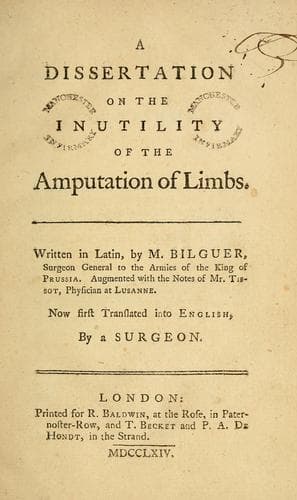
A dissertation on the inutility of the amputation of limbsBilguer, Johann Ulrich
History
A dissertation on the inutility of the amputation of limbs
Bilguer, Johann Ulrich
Amputation -- Early works to 1800
But if nature were even able to get the better of these difficulties,
there are others to which our[35] wounded men are subject, lodged
together in too great number in military hospitals, where the state of
wounds is rendered worse by a concurrence of several causes, and the
cure of those of the most simple kind is retarded. The principal of
these causes are want of cleanliness, an improper regimen, inconvenient
beds, a continual noise, which hinders sleep, bad air, frequent
removals from one place to another, and conducted in an inconvenient
manner; these circumstances greatly contribute to make the instances
of people recovering who are severely wounded near the upper part of
the thigh, where the bone is shattered, so uncommon. But if any should
pretend to say that there are none cured by the method described
§ XXXV. I shall only, in answer, produce the invalide soldiers
themselves, who are at present, some in the country, others in the
hospitals, whose recovery demonstrates the contrary. I acknowledge that
this method is difficult and tedious, and that more die than recover;
these, however, are not sufficient reasons for declaiming against, or
intirely condemning it, as it is the only expedient left, amputation at
the shoulder, or upper part of the thigh, being an operation not only
difficult, but highly precarious.
FOOTNOTES:
[33] M. Morand, the father, was the first who took off the arm at
the joint of the shoulder. Mr. Le Dran performed it soon after in
the presence of the most eminent surgeons of Paris, Messieurs Petit,
Marechal, La Peyronie, Arnaud, &c. which number of witnesses, making
his operation more extensively known, that of Morand has, as it
were, been forgotten, and Mr. Le Dran has passed for having been the
inventor. Mr. Bromfield performed it successfully within these few
years at London; but notwithstanding a few cases whose event has
been favourable, it is a very dangerous operation, and has sometimes
miscarried. Dr. Home, an eminent physician at Edinburgh, equally a
promoter of agriculture, medicine, and the arts, relates, that in the
former war, he saw Mr. Mitchel perform the operation on two soldiers,
where the os humeri was fractured as high as the joint, and who both
died a few days after: It is true, he remarks that they were both in
a bad way when the amputation was performed; but he adds, that this
operation appears extremely dangerous, even when performed with every
favourable circumstance. _Medical facts and experiments, p. 114_. With
respect to the thigh, there is little room to hope that the struggle
that is made to determine, when and how it should be taken off at
the articulation, can be attended with the success which some people
seem to expect from it. If such an operation should take place, it
will perhaps very soon be asked, whether it ought not to be publicly
condemned? TISSOT.
Public-domain text, read in full here on John Shaqi.
Reviews
Reviews
No reviews yet
Be the first to share your thoughts on this work.
Join the Discussion
Join the discussion
Sign in to leave a comment or review.
Sign InorCreate an account