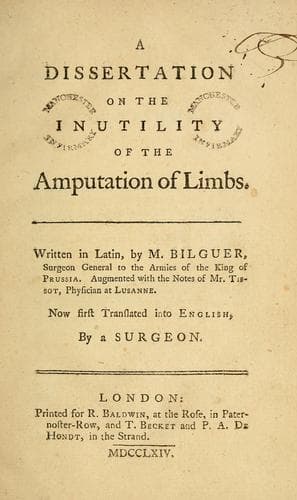
A dissertation on the inutility of the amputation of limbsBilguer, Johann Ulrich
History
A dissertation on the inutility of the amputation of limbs
Bilguer, Johann Ulrich
Amputation -- Early works to 1800
This success, partly owing to the efforts of nature, and partly to the
means employed by art, strongly encouraged me almost never to have
recourse to amputation, but to try every kind of remedy, internal as
well as external, calculated to preserve the lives as well as the
limbs of the unfortunate sufferers. My first attempts, so far from
being unfavourable, confirmed me more and more in the opinion, that
parts which have sustained the most considerable injuries, will much
oftener get well than what is commonly believed: And although this
opinion does not seem to be countenanced by many eminent physicians and
surgeons; although I do not flatter myself I shall be able to induce
them to alter their sentiments, I hope nevertheless, that some others,
encouraged by my example, and this account of my success, will have
the courage to follow the same method, and that their authority may
afterwards contribute to convince the most incredulous.
SECT. IV.
But supposing, what I do not apprehend can be the case, that all
the gentlemen of the profession should agree in declaring my method
absolutely useless, the rest of mankind at least, will be obliged to
me for my endeavours to mutilate the wounded as little as possible; as
most people are shocked at the mention of any amputation, or at the
sight of a poor creature who has lost an hand, an arm, a foot or leg,
wretchedly crawling along upon crutches or a wooden leg; and consider
the total privation of a limb, as a much greater misfortune than when
it is preserved, though perhaps unshapely, and uncapable of performing
several of its primitive functions. If one reflects how much every body
dreads the pain occasioned by the slightest incision, he will easily
conceive the degree of horror a person must feel at the thought of
amputation, and why many patients chuse rather to die than to submit
to it[3]. Hence it is so uncommon to find men, like count Mansfeld,
so famed in the war that lasted thirty years, who caused his wounded
arm to be taken off amidst the sound of trumpets and beating of drums;
or like the country fellow, whom Dr. Schaarschmid, late an eminent
physician at Berlin, mentions in his collection of observations and
remarks on physic and surgery, who cut off his own mortified leg with a
saw, very unfit for such an operation[4].
FOOTNOTES:
[3] I would not chuse to lay much stress on this argument; for if
one weighs the circumstances of pain, the amount of what the patient
suffers from the treatment necessary for saving the limb, will often be
equal to that arising from amputation. But the two strongest reasons
for prefering Mr. Bilguer's method is, the saving the limb as well
as the life of the patient; the loss of which is often occasioned by
amputation, but never by the pain of an incision. It is also true, that
pain when slighter, though longer continued, is more easily supported
by the patient. TISSOT.
Public-domain text, read in full here on John Shaqi.
Reviews
Reviews
No reviews yet
Be the first to share your thoughts on this work.
Join the Discussion
Join the discussion
Sign in to leave a comment or review.
Sign InorCreate an account