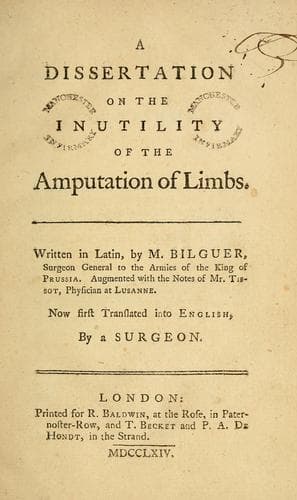
A dissertation on the inutility of the amputation of limbsBilguer, Johann Ulrich
History
A dissertation on the inutility of the amputation of limbs
Bilguer, Johann Ulrich
Amputation -- Early works to 1800
[4] To these instances may be added, that of the son of Thomas
Koulichan, a captain in the Austrian service, who, being wounded in the
leg, and the bones shattered, in one of the latter battles of the war,
held a candle with one hand and extracted the splinters with the other.
He exhibited many other proofs, not only of courage in the field, but
also of that fortitude in bearing pain which is very different from the
other, and much more seldom met with. TISSOT.
SECT. V.
But lest I should be charged with being weakly influenced by the cries
of the patient, and with wanting that kind of fortitude which Celsus[5]
thinks requisite in a surgeon, in treating of this operation, I shall
take it for granted that the patients are men like those I have just
now mentioned, and that an inordinate desire of life, an uncommon
strength of mind, religion, and other moral reasons, induce them to
consider pain as nothing, when it affords them any hope of preserving
life.
It is foreign to my plan to inquire who was the first who attempted
this operation, or to trace the history of it in the works of the
ancients. I shall only take notice, that such wounded men as recovered,
after having lost a limb by some accident, without doubt, shewed the
possibility, and suggested the first hint of trying this operation.
Neither shall I dwell upon the various methods of performing it from
the infancy of the art to the present time; they are described in
other books[6], and I do not purpose giving a compleat treatise on
amputation. I shall not even touch upon what is already generally known
on this subject, but as little as I possibly can: This is the best way
of handling any particular point; and I hope all those who pay more
regard than I do to scholastic form, will pardon my inattention to
regularity of method and stile, when they are informed how much my time
is engaged; others will excuse me, when they call to mind the remark of
Celsus, that diseases are cured by proper remedies, not by a display of
eloquence.
FOOTNOTES:
[5] _Celsus de re medica_, l. 7. præf. Nevertheless Mr. Dionis, in
his course of operations, (_Demonstr. 2, Art. 9._) acknowleges, that
even the most intrepid surgeons tremble at the instant they are going
to perform this operation. Of all the operations, says he, that which
occasions the greatest horror, is the amputation of a thigh, a leg
or an arm. When a surgeon is about to take off a limb, and reflects
on the cruel means he must employ, he cannot help feeling a tremour,
and pitying the misfortune of the poor patient, who is under a fatal
necessity of being deprived, for life, of a part of his body. And in
another place he says, This operation ought rather to be performed by a
butcher than by a surgeon.
[6] Memoirs of the Royal Academy of Sciences, 1732. Art. 7.
SECT. VI.
To prove what I have advanced, I shall begin with enumerating those
accidents for which amputation has been hitherto deemed necessary. I
shall reduce them to six.
Public-domain text, read in full here on John Shaqi.
Reviews
Reviews
No reviews yet
Be the first to share your thoughts on this work.
Join the Discussion
Join the discussion
Sign in to leave a comment or review.
Sign InorCreate an account