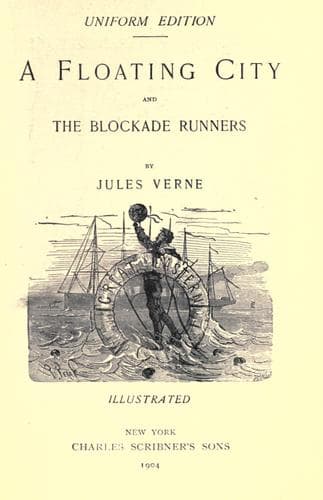
A Floating City, and The Blockade Runners — John Shaqi
A Floating City, and The Blockade RunnersVerne, Jules
History
A Floating City, and The Blockade Runners
Verne, Jules
Great Eastern (Steamship) -- Fiction; United States -- History -- Civil War, 1861-1865 -- Blockades -- Fiction
We had thus made two hundred and twenty-seven miles since noon the day
before.
I did not see Fabian once during the day. Several times, uneasy about
his absence, I passed his cabin, and was convinced that he had not left
it.
He must have wished to avoid the crowd on deck, and evidently sought to
isolate himself from this tumult. I met Captain Corsican, and for an
hour we walked on the poop. He often spoke of Fabian, and I could not
help telling him what had passed between Fabian and myself the evening
before.
“Yes,” said Captain Corsican, with an emotion he did not try to
disguise. “Two years ago Fabian had the right to think himself the
happiest of men, and now he is the most unhappy.” Archibald Corsican
told me, in a few words, that at Bombay Fabian had known a charming
young girl, a Miss Hodges. He loved her, and was beloved by her. Nothing
seemed to hinder a marriage between Miss Hodges and Captain Mac Elwin;
when, by her father’s consent, the young girl’s hand was sought by the
son of a merchant at Calcutta. It was an old business affair, and
Hodges, a harsh, obstinate, and unfeeling man, who happened at this time
to be in a delicate position with his Calcutta correspondent, thinking
that the marriage would settle everything well, sacrificed his daughter
to the interests of his fortune. The poor child could not resist; they
put her hand into that of the man she did not and could not love, and
who, from all appearance, had no love for her. It was a mere business
transaction, and a barbarous deed. The husband carried off his wife the
day after they were married, and since then Fabian has never seen her
whom he has always loved.
This story showed me clearly that the grief which seemed to oppress
Fabian was indeed serious.
“What was the young girl’s name?” asked I of Captain Corsican.
“Ellen Hodges,” replied he.
“Ellen,—that name explains the letters which Fabian thought he saw
yesterday in the ship’s track. And what is the name of this poor young
woman’s husband?” said I to the Captain.
“Harry Drake.”
“Drake!” cried I, “but that man is on board.”
“He here!” exclaimed Corsican, seizing my hand, and looking straight at
me.
“Yes,” I replied, “he is on board.”
“Heaven grant that they may not meet!” said the Captain gravely.
“Happily they do not know each other, at least Fabian does not know
Harry Drake; but that name uttered in his hearing would be enough to
cause an outburst.”
I then related to Captain Corsican what I knew of Harry Drake, that is
to say, what Dr. Dean Pitferge had told me of him. I described him such
as he was, an insolent, noisy adventurer, already ruined by gambling,
and other vices, and ready to do anything to get money; at this moment
Harry Drake passed close to us; I pointed him out to the Captain, whose
eyes suddenly grew animated, and he made an angry gesture, which I
arrested.
“Yes,” said he, “there is the face of a villain. But where is he going?”
Public-domain text, read in full here on John Shaqi.
Reviews
Reviews
No reviews yet
Be the first to share your thoughts on this work.
Join the Discussion
Join the discussion
Sign in to leave a comment or review.
Sign InorCreate an account